Buying a home rowing machine is really a decision about resistance. Hydraulic cylinders, a spinning fan, and a tank of water all put you in the same seated position and all give you something to pull against, but they feel different, they cost different amounts, and they ask different things of you after the workout is over. Most people who end up with a rower they never use picked the wrong resistance type for their space and their training, not the wrong brand.
That is the part of the purchase I care about most as a coach. A home rowing machine that matches how you actually train gets used three times a week. One that does not becomes the most expensive drying rack in the house. So before you compare models, compare mechanisms, and be honest about how much room you have and whether you want pacing feedback or just a pull.
Related: Rowing Form Basics: Fixing the Catch and the Finish →
Quick answer
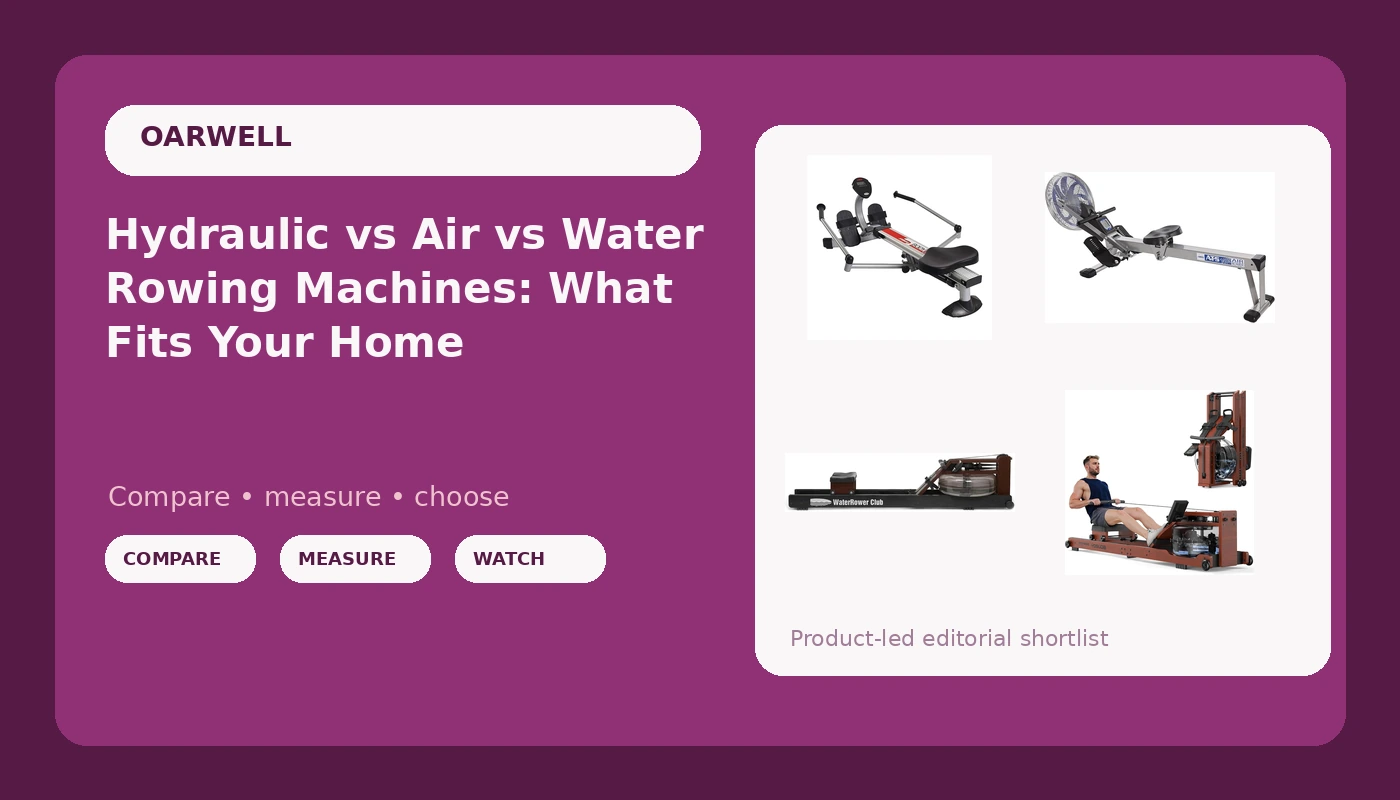
Resistance type and footprint decide almost everything else. A hydraulic rower is the most compact and the least expensive way to start. An air rower gives you resistance that rises with your effort and pacing numbers you can trust. A water rower gives you the smoothest feel from catch to finish, plus the visual of moving water, at the cost of a tank you have to look after. Foldability matters as much as resistance if you train in a living room. For a small apartment on a modest budget, the YOSUDA Water Rowing Machine is the natural starting point. For a dedicated training corner where you want the classic air-erg feel, the Stamina Elite ATS Air Rower. For the smallest possible footprint at the lowest cost, the Stamina Hydraulic Rowing Machine. And for a permanent, handcrafted water rower with the S4 BLE monitor, the WaterRower Club.
Four useful options
| Model | Best fit | What stands out |
|---|---|---|
| YOSUDA Water Rowing Machine Foldable for Home Use 5.8 Gal Large Water Tank | Small homes that need to put the rower away | Water resistance in a foldable frame with a 5.8-gallon tank |
| Stamina Elite ATS Air Rower - Smart Workout App, No Subscription Required - Upgraded Foldable Rowing Machine - LCD Monitor | Rowers who want honest pacing numbers | Air resistance, a foldable frame, and an app with no subscription |
| Stamina Hydraulic Rowing Machine, BodyTrac Glider with Cylinder Resistance, 250 Lbs | The smallest budget and the smallest corner | Cylinder resistance and a 250 lb weight capacity |
| WaterRower Club Rowing Machine with S4 BLE Monitor | A permanent spot and a long-term buy | USA-made handcrafted water rower with the S4 BLE monitor |
The foldable water rower for tight spaces: YOSUDA Water Rowing Machine
The trade-off with any water rower is the tank. Water needs periodic attention, and a folding frame adds a joint that has to lock solidly every time you set it up. Foldability is a real advantage only if you actually fold it and unfold it, which is why I tell people to count the number of steps between "stored" and "ready to row." If that number is high, the machine stops coming out. Check the folded dimensions against your closet or wall before you buy, not after.
The air rower that skips the subscription: Stamina Elite ATS Air Rower
Air rowers are the machines I put beginners on, because the resistance curve teaches you something: rush the stroke and the flywheel punishes you, slow down and smooth out and the work gets sustainable. The no-subscription detail matters more than it sounds. A rower that keeps working after the free trial ends is a rower you keep using. The one thing to expect from air resistance is noise. It is the sound of a fan moving air, and it does not disappear.
The compact hydraulic option: Stamina Hydraulic Rowing Machine, BodyTrac Glider
Hydraulic resistance comes from pistons rather than a flywheel, and it does not feel like a boat. It feels like a resistance band with a seat. What it does give you is a short, simple machine that fits where nothing else fits, at a price that lets you test whether rowing is something you will stick with. If you buy this one, treat it as an on-ramp, not a destination, and keep your expectations on the feel rather than the numbers.
The handcrafted water rower: WaterRower Club Rowing Machine with S4 BLE Monitor
This is the one you buy when the rower is going to live in the room rather than in a closet. It is also the one that expects something from you: the tank is part of the machine, not an accessory, and it needs to be treated that way. The S4 BLE monitor is the detail that separates it from older water rowers, because Bluetooth means your sessions can go somewhere other than a notebook. If you are comparing this against a top air erg, the honest split is feel and appearance versus pacing data and community rankings.
Prices and availability may change. Product images, names, and retailer links must be matched by verified ASIN. Do not state a current price, rating, stock status, or measured result without current evidence.
How resistance type changes the workout
Air resistance is created by a fan that spins as you pull. The faster you drive, the more air you move, and the more resistance you feel. That relationship is why air rowers are the default for structured training: your effort and the machine's resistance are tied together, so a hard stroke feels hard and an easy stroke feels easy, without you touching a dial. The numbers on the monitor track that relationship.
Water resistance works the same way in principle, with a paddle wheel moving through a tank instead of a fan moving through air. The difference is in the feel. Water has more inertia, so the catch takes a little more to get moving and the finish releases more smoothly. Rowers who came from the water tend to describe it as the closest thing to the real thing, and they also tend to be the ones who remember to maintain the tank.
Hydraulic resistance is a different animal. Pistons or cylinders create the load, and the resistance is largely set by the cylinder rather than by how fast you pull. That makes for a compact machine and a very approachable price, but it also means the stroke does not reward rhythm the way an air or water machine does. It is a good tool for general conditioning and a poor tool for learning to pace.
What the monitor and the frame actually tell you
The monitor is not a bonus feature. It is the instrument that decides whether you can train with intent. Look for split, which is time per 500 meters, because split is the honest pace number. Calorie readouts on rowing monitors are estimates and should not drive your sessions. The WaterRower Club includes the S4 BLE monitor, which adds Bluetooth connectivity, and the Stamina Elite ATS Air Rower includes an LCD monitor plus a smart workout app that does not require a subscription.
The frame decides whether the machine fits you and your room. Rail length has to accommodate your leg drive at the finish, and a short rail will make a tall rower feel cramped no matter how good the resistance is. Weight capacity matters for durability as much as for safety, and the Stamina Hydraulic Rowing Machine is rated to 250 lb. Foldability is a frame feature, and it is only worth paying for if the folded machine genuinely fits where you plan to store it.
- Measure both the spot where you will row and the spot where the machine will live when you are not rowing.
- Decide whether you need split-based pacing, which points you toward air or water resistance.
- Match the mechanism to your noise situation, since air and water machines both make sound while you work.
- Budget for upkeep: water tanks need attention, and folding frames have joints that should be checked.
- If you can, sit on the machine before buying and check that the rail length suits your height.
Practical guidance for a small home gym
- Put the rower where you will actually use it. A machine that has to be carried between rooms gets used once a week at best.
- Learn the catch and the finish before you chase pace. Most form breakdowns happen at the ends of the stroke, not the middle.
- Slow the stroke rate down when you are learning. A controlled 20 to 22 strokes per minute teaches more than a fast, sloppy 30.
- Set resistance deliberately on air machines and leave it alone. The damper changes the feel of the stroke, and constantly adjusting it makes your numbers meaningless.
- Track split, not calories, and write the number down. A log is what turns a rower into a training plan.
Which option should you choose?
Choose the YOSUDA Water Rowing Machine Foldable for Home Use 5.8 Gal Large Water Tank when you want water resistance but need to reclaim the floor afterward. Choose the Stamina Elite ATS Air Rower when you want air resistance, pacing numbers, and an app that keeps working without a subscription. Choose the Stamina Hydraulic Rowing Machine, BodyTrac Glider when budget and footprint are the two constraints that matter most and you want a simple way to start. Choose the WaterRower Club Rowing Machine with S4 BLE Monitor when the rower has a permanent place in your home and you want handcrafted construction with the S4 BLE monitor.
The specs here come from the manufacturer listings rather than from a side-by-side session in your room, so treat dimensions, weight limits, and monitor features as things to confirm on the current listing before you order. Nothing in this group has a published measurement here that would justify calling one machine the quietest or the smoothest.
The bottom line
Pick the resistance mechanism first and the model second. Hydraulic gets you rowing for the least money in the least space, air gives you the pacing feedback that makes structured training possible, and water gives you the feel that keeps people coming back to the machine. The YOSUDA covers the small-space water rower case, the Stamina Elite ATS Air Rower covers air without a subscription, the Stamina Hydraulic covers the compact budget entry, and the WaterRower Club covers the permanent, handcrafted end of the range. Whichever you choose, the machine is only part of the workout. The other part is the stroke you bring to it.