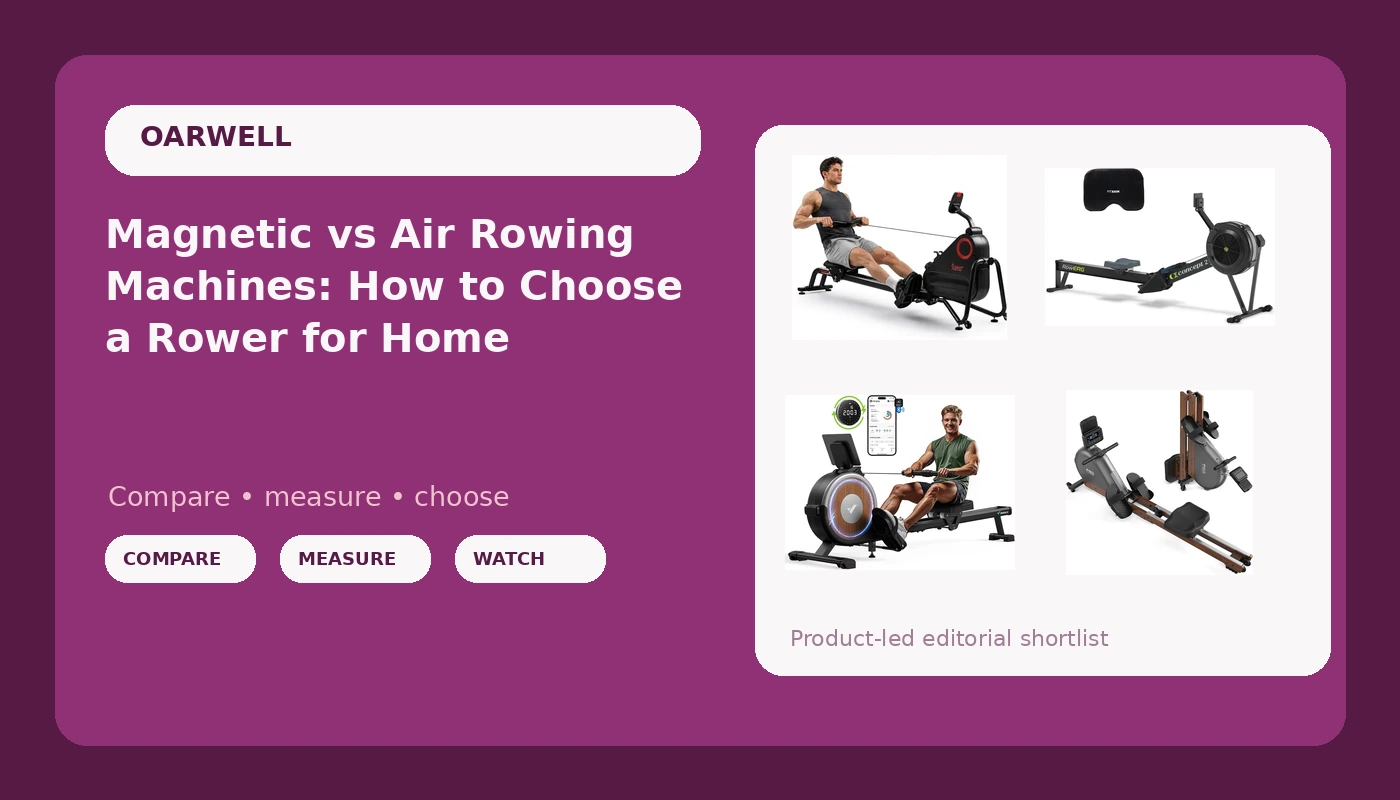
Most people shopping for a rowing machine for home start with price and end up with a machine they use for six weeks. The better first question is what kind of resistance sits under your feet, because that single choice decides how loud the machine is, how it stores, what the monitor can tell you, and how the stroke feels at the catch and the finish. Air resistance pushes back harder the faster you pull, which is why gyms are full of air rowers and why the pace standards in the sport come from them. Magnetic resistance holds a steadier, softer load and runs without a fan, which makes it a realistic option in an apartment, a small room, or a house where someone is asleep upstairs. Neither design is a trick. They are two different answers to the same question, and the four machines below cover both answers at very different budgets.
Related: How to Set the Damper and Read Your Split →
Quick answer
If you want pace numbers you can compare with other rowers, the Concept2 RowErg is the one built for that, because its PM5 monitor is designed around split and stroke rate and its air resistance is adjustable. If you want magnetic resistance for a small room or a shared wall, look at the Merach Q1S or the Sunny Health & Fitness Smart Magnetic Rowing Machine. If storage is your hard constraint, the YOSUDA Wooden Rowing Machine folds. All four are legitimate home machines, and the real differences are resistance type, what the monitor shows, and how much floor the frame demands.
Four useful options
| Model | Best fit | What stands out |
|---|---|---|
| Concept2 RowErg Indoor Rowing Machine | Rowers who want comparable pace data | Adjustable air resistance, PM5 monitor, device holder, FitXion seat cushion included |
| Merach Q1S Magnetic Rowing Machine Indoor | Small rooms and shared walls | Dual slide rail with magnetic resistance, described in the listing as quiet and smooth |
| Sunny Health & Fitness Smart Magnetic Rowing Machine | A first rower with connected features | Magnetic resistance with a smart, full-body workout positioning |
| YOSUDA Wooden Rowing Machine for Home | Tight storage and shared living space | Wooden frame with a folding magnetic design |
The air standard: Concept2 RowErg Indoor Rowing Machine
The case for air resistance is that the machine responds to you. Pull harder and the flywheel bites more, so the effort curve matches the stroke instead of sitting flat underneath it. That response is what makes a pace number meaningful: time per 500 meters is an honest measure on an air rower because the resistance is not fixed by a lever. The damper setting on this machine is not a difficulty dial in the way people assume. It changes how the flywheel feels, and on a Concept2 the number you actually want to watch is the drag factor the monitor reports, which tells you what the resistance really is on that machine on that day. The trade-off is sound and space. An air rower makes noise on every stroke, because there is a fan spinning, and the frame is longer and heavier than a folding magnetic machine. What you are buying here is a monitor and a frame built for frequent, hard use, and a pace number that means the same thing to you as it does to a stranger on the internet.
The magnetic dual-rail pick: Merach Q1S Magnetic Rowing Machine Indoor
Treat quiet and smooth as the manufacturer's wording rather than a measured number, because a decibel figure means nothing until someone puts a meter next to the machine. What is not marketing is the mechanical difference: no fan means no air rush, and that alone changes whether you can row at 6 a.m. in a second-floor apartment. A dual rail also matters more than buyers expect. Single-rail magnetic rowers put the seat on one track, and when you pull hard the seat can rock, which shows up as a click or a wobble that gets worse over months. Two rails spread that load. The compromise with magnetic resistance is that it does not reward a harder pull with more resistance the way air does, so the stroke feels more like a steady load and less like a flywheel you are fighting. The monitor on machines in this class is usually simpler than a PM5, so check what it displays before you buy, and remember that a magnetic rower is a machine you buy for the workout you will do, not for the pace comparison you might do.
The smart magnetic budget pick: Sunny Health & Fitness Smart Magnetic Rowing Machine
Smart is the vaguest word in home fitness, so it deserves a definition before you spend on it. Sometimes it means the monitor connects to a phone app and logs workouts. Sometimes it means the machine pairs with a third-party training app that runs on a subscription. Sometimes it means a tablet holder and a Bluetooth heart-rate connection. Any of those can be worth having, but only one of them costs you money every month, and that is the one to identify first. A connected magnetic rower makes the most sense for someone who wants guided sessions and structure, because a rowing machine without programming is a machine you have to motivate yourself to use. The full-body framing is accurate in the sense that rowing drives legs, back, and arms in one movement, but it is also the kind of line that appears on every box. Judge this one on the resistance and the console, not the phrase.
The foldable wooden pick: YOSUDA Wooden Rowing Machine for Home
A fold is only worth paying for if you actually fold it, and the honest test is whether you will do that every single session. Most people fold a rower once, decide the process is annoying, and leave it out permanently, at which point they have paid for a hinge they never use. That said, if your only option is a living room that has to look like a living room, a folding wooden rower is a reasonable compromise, and a wooden frame genuinely photographs and lives better in that room than a black steel rail. Two cautions come with the category. First, folding frames usually trade some rigidity for the hinge, so a hard sprint start can feel less planted than a fixed frame. Second, wooden frames want a dry room; a damp basement is not the place for them. Magnetic resistance keeps this one quiet enough for shared walls, and the console on folding machines is typically basic, so check whether it shows split or only time and calories.
Prices and availability may change. Product images, names, and retailer links must be matched by verified ASIN. Do not state a current price, rating, stock status, or measured result without current evidence.
How air and magnetic resistance actually differ
An air rower uses a flywheel with vanes inside a cage. Every pull spins that flywheel and pushes air, and the faster it spins, the more air it has to move, so resistance climbs with your effort. That is the whole trick, and it is why air rowers feel like boats and why pace numbers on them are comparable from one machine to another. The damper setting on the side of the cage does not add or remove resistance in a simple way. It opens or closes how much air reaches the flywheel, which changes the feel and the drag. Two machines at the same damper setting can have different drag factors depending on altitude, dust in the cage, and how clean the flywheel is. That is why serious rowers work in drag factor, not damper numbers.
A magnetic rower replaces the fan with magnets and a metal flywheel, and the resistance comes from eddy currents rather than air. The load is smoother, the sound drops to a hum, and the machine can be built shorter because it does not need a big cage. What you lose is the direct link between effort and resistance. Pull harder on a magnetic rower and the flywheel spins faster, but the magnetic brake does not bite back the way air does, so the stroke feels steady rather than responsive. For steady-state work and general conditioning, that is fine. For interval training where the machine is supposed to punish you, it is a noticeable difference. The monitor tends to reflect the difference too. Air rowers in this class come with consoles built around split and stroke rate. Magnetic rowers in the entry range often show time, count, and calories first, and calories on any rowing monitor are an estimate, not a measurement.
A five-step way to decide
Work through these in order and the choice usually makes itself, because the first two steps eliminate half the market.
- Measure the floor space you can give up permanently, then measure it again including the space you need to sit down and stand up. If that number is small, a folding magnetic rower moves to the front.
- Decide whether you need comparable pace data. If you want to track split over months, join online rankings, or follow interval programs with target paces, an air rower with a proper monitor is the only sensible answer.
- Check what the console actually displays. Split and stroke rate are the numbers that improve your rowing. Calories are decoration, and a monitor that shows only calories will stop being interesting within a month.
- Think about sound and neighbors. A magnetic rower with no fan is the safer pick for an apartment, a shared wall, or early morning sessions, and any quiet claim is worth confirming with the current listing and reviews.
- Set the budget for the whole setup, not the machine alone. A floor mat, a heart-rate strap, and possibly an app subscription are part of the real cost, and they are the accessories you will use every session.
Before you buy: practical guidance
- Sit on the machine before you commit if you can, or check the seat height and rail length in the listing. Tall and short rowers need different things from a seat and a foot stretcher, and a machine that fits badly will not get used.
- Confirm the monitor shows time per 500 meters. If it does not, you are buying a machine for time and calories only, which is fine, but know that going in.
- Measure your ceiling if you plan to store the rower upright, and measure your doorway if you plan to move it between rooms.
- Read the current listing for weight capacity, warranty length, and what is included. Those details change between production runs and are the ones buyers regret missing.
- Learn the stroke before you judge the machine. Catch, drive, finish, recovery, with the legs doing most of the work, is 80 percent of the result and costs nothing.
Which option should you choose?
Choose the Concept2 RowErg Indoor Rowing Machine when you want pace data that means something, an adjustable air flywheel, and a machine built for hard and frequent use. Choose the Merach Q1S Magnetic Rowing Machine Indoor when you need magnetic resistance, a dual rail for a steadier seat, and a smaller footprint in a shared space. Choose the Sunny Health & Fitness Smart Magnetic Rowing Machine when you want a connected magnetic rower for guided, full-body sessions at an entry-level budget. Choose the YOSUDA Wooden Rowing Machine for Home when storage and appearance matter most and you will genuinely fold it between sessions.
None of this replaces the current product listing. Specifications, included accessories, weight limits, and warranties change, and noise descriptions here reflect manufacturer wording and the general difference between a fan and a magnetic brake rather than any measurement taken in your room. Confirm the details on the listing before you buy.
The bottom line
Resistance type is the decision, and everything else follows from it. An air rower gives you responsive resistance and honest pace numbers, which is why the Concept2 RowErg remains the reference machine for anyone who wants to train rather than just move. A magnetic rower gives you quiet operation, a smaller footprint, and a lower entry cost, which is why the Merach Q1S, the Sunny smart magnetic rower, and the folding YOSUDA all make sense for different rooms and different budgets. Pick the resistance you will live with, check that the monitor shows a split, and spend the rest of your attention on technique, because the machine is the smaller half of the workout.