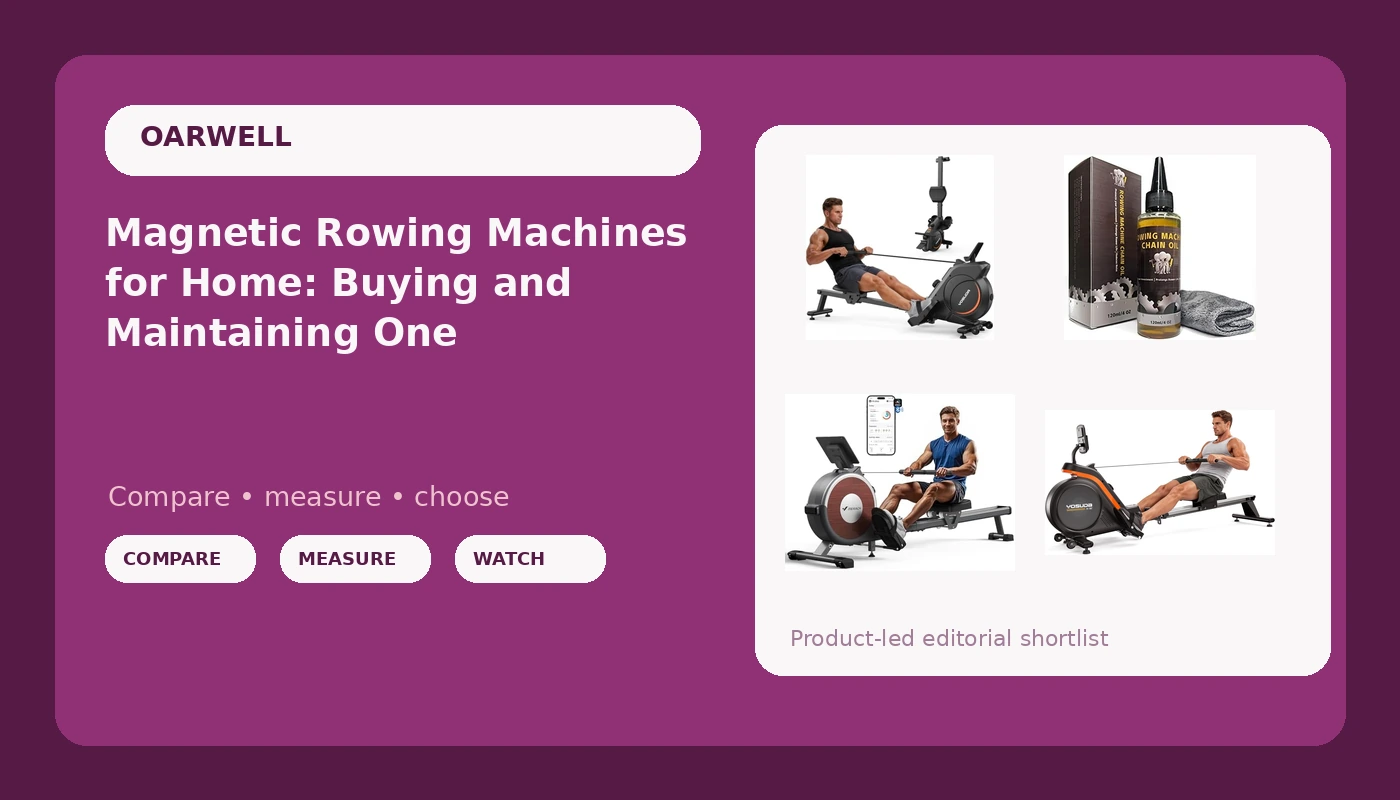
A magnetic rowing machine for home sits at the quiet, low-maintenance end of the rowing market. There is no fan roar, no water tank to treat, and on most models no chain to oil. That is also where the trouble starts. Because the resistance comes from magnets rather than from air or water, the feel of the stroke changes a lot from one machine to the next, and those differences almost never show up in a product photo. Two rowers can both advertise 16 levels of resistance and feel nothing alike underfoot. The four items below cover the practical spread of a home rowing setup: three magnetic rowers built for different spaces and riders, plus the one maintenance product that matters if you already own a chain-drive machine.
Related: How to Set the Damper and Read Your Split →
Quick answer
Decide what you want from the stroke before you compare machines. A magnetic rower gives you quiet operation, resistance you change with a dial, and a footprint that often folds away, which suits steady-state sessions, interval work in a shared room, and anyone who rows at odd hours. If you already own a chain-drive rower, the maintenance item here is the one that keeps it usable. If you are buying new, the deciding factors are rail length and seat travel, whether the monitor shows pace per 500 meters rather than only calories, and whether the folding mechanism works smoothly the tenth time you use it, not just the first.
Four useful options
| Model | Best fit | What stands out |
|---|---|---|
| Merach Q1S Magnetic Rowing Machine Indoor, Dual Slide Rail, Quiet & Smooth | Shared living space and riders who want a stable rail feel | Dual slide rail design with magnetic resistance in a compact indoor frame |
| YOSUDA Rowing Machine for Home, Magnetic Rower with 16-Level Resistance | A first home rower on a tight budget | 16 levels of magnetic resistance in a straightforward, simple frame |
| TreadLife Fitness Concept 2 Rowing Machine Chain Oil | Owners of chain-drive rowers, including Concept 2 models A through E | Made to lubricate and protect a chain from rust and dirt |
| YOSUDA PRO Magnetic Rowing Machine for Home Use, Foldable Rower with 400lbs Weight Capacity and 16 Level Resistance | Heavier riders and rooms where the machine has to disappear | Folding frame, 400 lb weight capacity, 16 resistance levels |
Dual rail magnetic rower: Merach Q1S Magnetic Rowing Machine Indoor, Dual Slide Rail, Quiet & Smooth
A dual rail design is the detail that separates this from most budget magnetic rowers. Two rails supporting the seat tend to feel steadier than a single beam, especially at higher stroke rates when your weight shifts forward and back quickly. The trade-off is footprint: a wider base needs more floor space and is less likely to fold into a closet. If the rower will live in a fixed spot in a living room or garage, that is a fair exchange. If it has to vanish between sessions, look at the folding option below instead.
Budget magnetic rower: YOSUDA Rowing Machine for Home, Magnetic Rower with 16-Level Resistance
Sixteen levels sounds like a lot until you use them. On a magnetic rower, the resistance dial changes how much effort it takes to pull, but it does not change how the stroke feels the way an air rower's fan does, where pulling harder makes the resistance rise on its own. That is not a flaw, it is the design. It means the lower half of the dial is usually where the usable work happens, and the top levels are there for short, hard efforts. Set expectations accordingly: this is a machine for building a habit and holding a steady pace, not for replicating the resistance curve of a Concept 2.
Chain maintenance: TreadLife Fitness Concept 2 Rowing Machine Chain Oil
This is the least exciting item in the article and the one that decides whether a chain-drive rower still feels right in three years. A dry chain runs rough, sheds grit onto the rail, and starts to make noise at the catch. It is also the cheapest thing you can do to protect a machine that costs many times more than the oil. If you own a magnetic rower, skip this section entirely; there is no chain to service. If you own a Concept 2 or another chain-drive machine, this is the consumable to keep on the shelf.
Foldable, higher capacity: YOSUDA PRO Magnetic Rowing Machine for Home Use-Foldable Rower with 400lbs Weight Capacity and 16 Level Resistance
A folding rower solves a real problem and creates a smaller one. The frame has a joint in it, and joints are where flex shows up, especially under a heavier rider pulling hard. That does not make folding designs bad, it makes the hinge a thing to inspect and to keep tight. The honest test is whether you actually fold it. A rower that stays unfolded in the corner is fine; a rower that stays folded because unfolding it is a two-minute chore is a rower you will stop using. Be truthful about which person you are before paying for the folding feature.
Prices and availability may change. Product images, names, and retailer links must be matched by verified ASIN. Do not state a current price, rating, stock status, or measured result without current evidence.
What magnetic resistance actually does to the stroke
On an air rower, the resistance curve is self-regulating. Pull harder and the fan spins faster, so the resistance rises with your effort and drops when you ease off. That is why a hard stroke feels heavy and a light stroke feels easy, and it is the closest thing to the feel of a boat on the market. Magnetic resistance does not work that way. The magnets create a fixed load at whatever level you dial in, so the effort is more constant through the stroke and does not scale as sharply with how hard you pull.
That changes how you train, not just how the machine feels. Steady-state sessions at a fixed resistance are easy to hold, which is why magnetic rowers work well for long, even pieces and for people who want to row while watching something. Intervals still work, but you change the intensity by changing your stroke rate and how hard you drive rather than by feeling the machine push back. Sprint work on a magnetic rower is honest work; it just does not have the escalating resistance that makes an air rower feel alive under a hard ten-stroke push.
The other consequence is noise. Magnetic resistance itself is quiet because nothing is moving air or water. Any noise you hear on a magnetic rower comes from somewhere else: the seat rollers on the rail, the footrest straps, the frame under load. That is useful to know, because it tells you where to look if the machine starts talking to you.
What a home rower actually needs from maintenance
Very little, if it is magnetic, and a scheduled amount if it is a chain-drive machine. The two failure points on any rower are the rail and the drive system. The rail collects dust, hair, and grit, which works into the seat rollers and produces the click or squeak that tells you something is wearing. A wipe down the rail and a check of the rollers takes under a minute and prevents most of it.
On a chain-drive rower, the chain is the part that ages. A chain that runs dry wears faster, runs rougher, and drops grit onto the rail below it. Lubricating it on a schedule, rather than waiting until it feels gritty, is the single highest-value maintenance habit in indoor rowing. Follow the product's own instructions for how much to apply and how often.
Beyond that, check the fasteners. Bolts on a home rower loosen over months of use, particularly around the footrests and the rail connection, and a loose bolt is how a stable machine becomes a wobbly one.
- Measure the floor space, including the folded footprint if you plan to store it upright.
- Sit on the machine before buying if you can, and check rail length against your leg length and the footrest position.
- Read what the monitor displays. Pace per 500 meters and stroke rate matter more than a calorie estimate.
- Match the resistance type to your training: magnetic for quiet, steady work; air or water if you want resistance that rises with effort.
- Budget for upkeep: chain oil for chain-drive machines, a rag for the rail, and a place the machine actually lives.
Practical guidance for the first month
- Strap the footrest across the ball of your foot, not the toes, and keep the heel connected at the catch.
- Pick a stroke rate you can hold for twenty minutes before you chase speed. Pace follows form, not the other way around.
- Wipe the rail and the seat rollers regularly. A squeak is a signal, not a personality trait of the machine.
- If you own a chain-drive rower, oil the chain on a schedule rather than when it starts to complain.
- Fold the machine only if you will unfold it. A folded rower is a rower you are not using.
Which option should you choose?
Choose the Merach Q1S Magnetic Rowing Machine Indoor, Dual Slide Rail, Quiet & Smooth when the rower has a permanent spot and you want a dual rail frame under a magnetic drive. Choose the YOSUDA Rowing Machine for Home, Magnetic Rower with 16-Level Resistance when you want the simplest possible entry into home rowing without paying for features you will not use. Choose the TreadLife Fitness Concept 2 Rowing Machine Chain Oil when you already own a chain-drive rower and want to keep the chain lubricated and protected. Choose the YOSUDA PRO Magnetic Rowing Machine for Home Use-Foldable Rower with 400lbs Weight Capacity and 16 Level Resistance when storage space is tight or you need the higher weight rating.
One caveat applies to all four: the specifications above come from the product listings, not from a bench test in your room. Rail length, seat height, and monitor behavior are the things you can only judge against your own body and your own space, so treat the listed numbers as a starting filter rather than a verdict.
The bottom line
A magnetic rower is a quiet, compact machine with a resistance dial, and it rewards you most when you accept what it is: excellent for steady sessions and honest interval work, different in feel from an air rower, and simple to live with. The Merach Q1S leans toward a stable dual rail frame, the YOSUDA is the plainest way in, and the YOSUDA PRO trades a hinge for storability and a higher weight rating. If your machine has a chain instead of magnets, the chain oil is the item that keeps it running smooth. Whichever you pick, the machine is only part of the workout. Form and consistency do the rest.