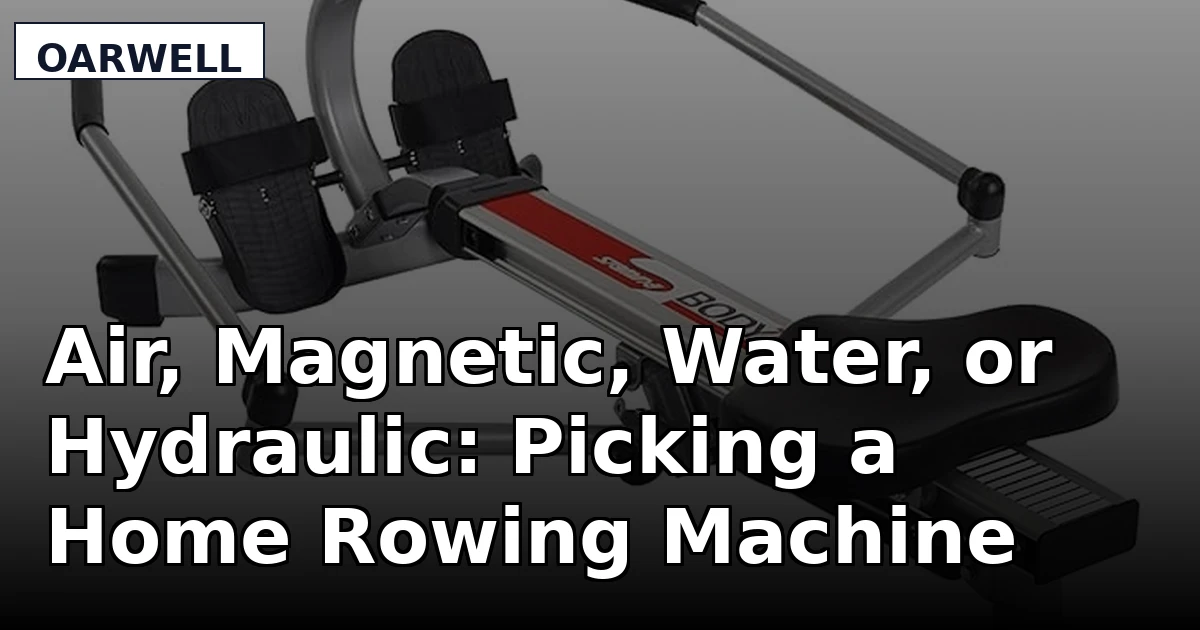
Most people shopping for a home rowing machine start with the wrong question. They ask which machine is the best one, and the honest answer is that the question skips a step. The four common home rowing machine types, air, magnetic, water, and hydraulic, do not feel alike under load, and you notice the difference on the very first stroke. An air rower fights back harder the faster you pull. A magnetic rower holds whatever resistance you set, no matter how hard you drive. A water rower feels like a boat and asks you to maintain a tank. A hydraulic rower folds small and wants a shorter, punchier stroke. Choose the resistance type that matches how you will actually train and where the machine will live, then choose the model.
Related: How to Set the Damper on an Air Rower Without Wrecking Your Split →
Quick answer
No machine in this group is the right one for everybody, and none of the four is objectively the best. Air resistance suits interval work and hard steady-state sessions. Magnetic resistance suits apartments, shared walls, and anyone who rows early or late. Water resistance suits people who want the closest thing to on-water feel and will keep up with a tank. Hydraulic resistance suits tight spaces and short, occasional sessions. Match the resistance type to your room and your training plan first, because that decision is harder to undo than any feature comparison.
Four useful options
| Model | Best fit | What stands out |
|---|---|---|
| Stamina Elite ATS Air Rower | Interval training and hard steady-state work | Air resistance, a folding frame, and an LCD monitor with an app the maker says needs no subscription |
| Merach Q1S Magnetic Rowing Machine Indoor, Dual Slide Rail, Quiet & Smooth | Apartments and shared walls | Magnetic resistance, which removes the fan and the water tank, plus a dual slide rail |
| WaterRower Club Rowing Machine with S4 BLE Monitor | Rowers who want the water feel and will maintain it | Water tank resistance, a handcrafted wood frame made in the USA, and an S4 BLE monitor |
| Stamina Hydraulic Rowing Machine, BodyTrac Glider | Small rooms and light, occasional use | Hydraulic cylinder resistance, a 250 lb capacity, and a compact folding design |
The air-resistance option: Stamina Elite ATS Air Rower
Air resistance is the standard for a reason. The fan is coupled to your pull, so the harder and faster you drive, the more the machine pushes back. That is the behavior you want for sprint intervals, and it is also why air rowers reward good sequencing: legs, then back, then arms, with a relaxed recovery. If you have ever wondered why experienced rowers obsess over split time, it is because an air rower gives you an honest number to chase. The trade-off is noise. A fan moving that much air is the loudest resistance type here, and no app setting changes that. If your machine will sit above a downstairs neighbor, plan around it. The folding frame is a real benefit in a small apartment, but any folding joint is a part to inspect periodically for play.
The magnetic-resistance option: Merach Q1S Magnetic Rowing Machine Indoor, Dual Slide Rail, Quiet & Smooth
Magnetic resistance is the quietest type at the machine itself, because there is no fan chopping air and no water sloshing in a tank. That matters more than most buyers expect, since the loudest part of a rowing session is often the machine, not you. The trade-off is how resistance behaves. A magnetic brake gives you a level you select and then holds roughly constant, so the stroke does not get heavier as you drive harder. For steady 20-minute sessions and technique work, that consistency is pleasant. For race-start simulation, it is not. At low settings, magnetic rowers can also feel light and disconnected, almost like stirring rather than pulling. Pair a magnetic machine with a monitor that shows split and stroke rate, and with a habit of slowing the stroke down, because the machine will not force either on you.
The water-resistance option: WaterRower Club Rowing Machine with S4 BLE Monitor
Water resistance behaves most like a boat, because the drag rises with effort in the same way a hull's drag does. That is why rowers who came from the water tend to like it immediately, and why the sound of the tank is part of the appeal rather than a nuisance. The honest trade-off is maintenance. A water tank is a living system: it needs treatment to stay clear, it needs to be kept level, and it needs to be drained and moved carefully if you relocate. The wood frame is the other half of the pitch, since this is the machine you are least likely to hide in a garage. On the electronics side, the S4 BLE monitor is a data transmitter more than a coaching screen, so if you want guided classes or a big display, plan to run that from a tablet or phone instead. Set expectations accordingly and it is a beautiful machine to row on.
The hydraulic-resistance option: Stamina Hydraulic Rowing Machine, BodyTrac Glider
Hydraulic cylinders are the oldest and simplest answer to rowing resistance: pistons provide the load, and the whole machine can be built short and light. That is the appeal if your only available floor space is the gap beside a couch. The feel is the compromise. A hydraulic stroke tends to be shorter than an air or water stroke, and the resistance can differ between the drive and the return, so it rewards a compact, controlled motion rather than a long, connected one. Treat this as a machine for light, occasional sessions and for building the habit of sitting down and pulling, not as a platform for high-volume interval training. On any compact or folding rower, check the rail and the seat for flex and noise, because a seat that clicks on the rail will wear on you long before the resistance does.
Prices and availability may change. Product images, names, and retailer links must be matched by verified ASIN. Do not state a current price, rating, stock status, or measured result without current evidence.
What actually changes when you change resistance type
Resistance type drives four things that matter more than any spec sheet line. First, how the load responds to effort. Air and water both scale with how hard you pull, which makes them feel connected and makes hard efforts feel hard. Magnetic and hydraulic deliver a set level, which is predictable and quieter but flatter. Second, noise. The fan on an air rower and the tank on a water rower are the two loudest elements in this category, and magnetic and hydraulic machines avoid both. Third, maintenance. Water needs treatment and leveling, hydraulic cylinders are sealed and simple, air needs occasional dust attention around the fan, and magnetic needs almost nothing. Fourth, footprint and storage. A full-length rail rower needs roughly its own length plus clearance behind it, while folding and compact designs trade some stroke length for floor space.
One more variable sits on top of all of this: the monitor. A monitor that shows split per 500 meters and stroke rate lets you compare sessions and pace yourself honestly. A monitor that leads with calories is mostly guessing, and calories vary enough between machines that the number is not comparable across them. If a machine's display cannot give you pace and rate, budget for a phone or tablet to fill that role.
How to choose in five steps
- Measure the space first, including the length of the rail, the clearance behind the seat at the finish, and the height if you plan to store it upright or folded.
- Decide when you will row and who is nearby, then weigh how much machine noise your floor, walls, and household can absorb.
- Decide what your sessions look like. Intervals and hard steady state want resistance that scales with effort. Short, easy sessions do not.
- Decide your maintenance appetite honestly, especially whether you will treat and level a water tank or prefer a sealed system.
- Check the monitor for split and stroke rate, and check whether the machine can send data to an app you already use.
What to check before you order
- Rail length and seat height against your own height, since a short rail forces a cramped finish and a tall rail can feel long on the recovery.
- Weight capacity against the heaviest person who will use it, such as the 250 lb rating on the BodyTrac Glider.
- Monitor metrics, specifically whether pace per 500 meters and stroke rate are shown.
- Noise sources, since a fan or a tank is audible in a way a magnetic brake is not.
- Storage dimensions when folded or upright, and whether the machine realistically gets put away after each session.
- Warranty terms and parts availability, because seats, bungees, and monitor batteries are the parts that wear.
Which option should you choose?
Choose the Stamina Elite ATS Air Rower when you want resistance that rises with effort, you plan to train intervals or hard steady sessions, and machine noise is not a constraint. Choose the Merach Q1S Magnetic Rowing Machine Indoor, Dual Slide Rail, Quiet & Smooth when the machine lives in an apartment or a shared space, or when you row early or late and need the quietest resistance type. Choose the WaterRower Club Rowing Machine with S4 BLE Monitor when the on-water feel and the wood frame matter to you and you will keep up with tank maintenance. Choose the Stamina Hydraulic Rowing Machine, BodyTrac Glider when floor space is tight and your sessions are short, light, and occasional.
None of these machines replaces technique. Rowing well is mostly sequencing and patience, and a machine cannot coach the catch for you. Whatever you buy, plan to spend your first few sessions on stroke rate and length rather than intensity, and treat the monitor as a pace tool rather than a scoreboard.
The bottom line
Resistance type decides how a home rowing machine feels, how loud it is, and how much upkeep it asks for, and those three things decide whether you keep using it. Air suits hard training and tolerates noise. Magnetic suits shared walls and steady work. Water suits rowers chasing feel and willing to maintain a tank. Hydraulic suits small rooms and light use. Pick the type that fits your room and your sessions, confirm the monitor shows pace and rate, then compare the specific models on this list at their current listings before you commit.