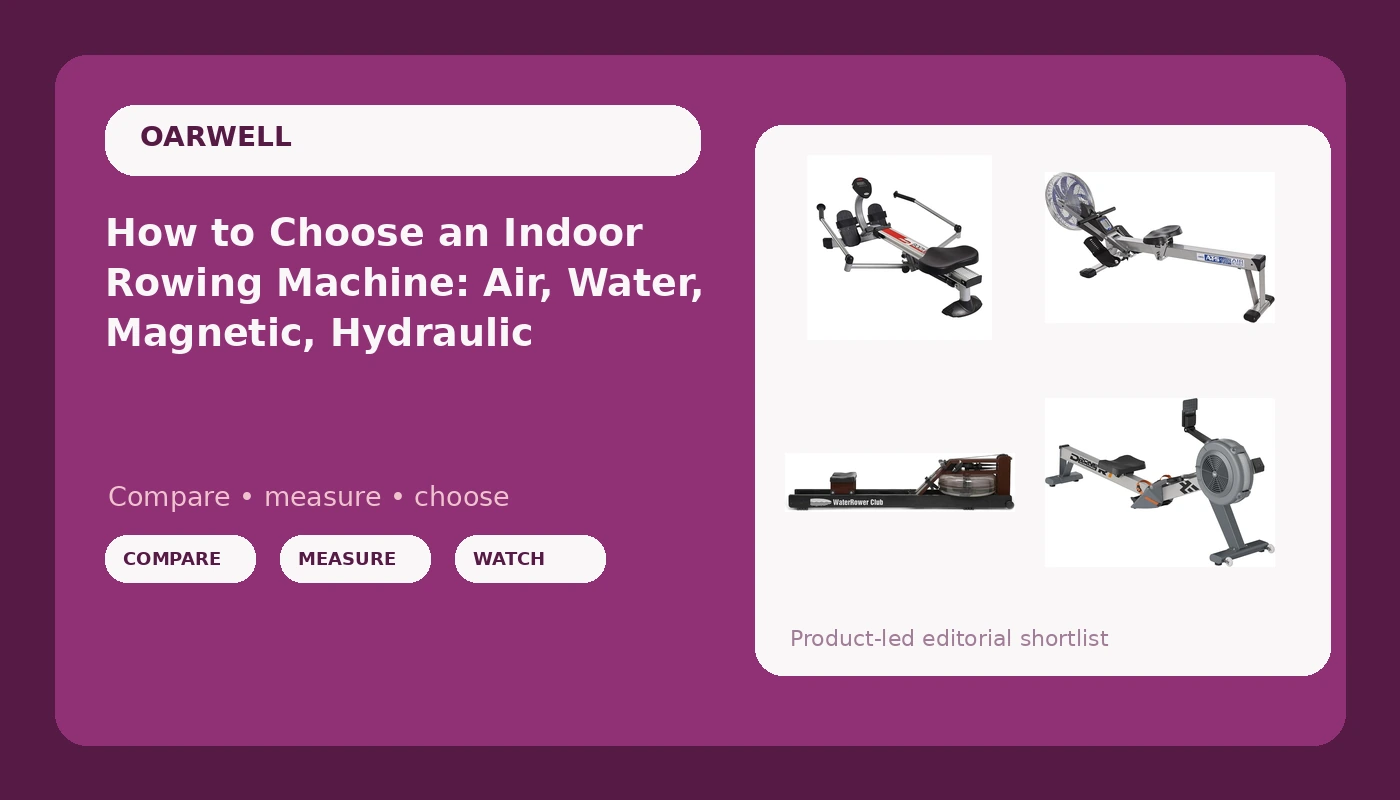
Most people shopping for indoor rowing machines think they are comparing four products. They are actually comparing four resistance systems, and that single choice decides almost everything else: how the stroke feels at the catch, how loud the machine is in a spare bedroom, how much of the year it spends folded against a wall, and how much upkeep it wants by year three. Resistance type is also the hardest part of the decision to undo later, because you cannot retrofit a fan onto a hydraulic frame. Get it right and the rest of the shopping list gets short. Get it wrong and you will own a very sturdy clothes rack.
Related: How to Set the Damper on an Air Rower →
Quick answer
Resistance type comes before brand. Hydraulic cylinders keep a machine short, light, and simple. Dial-set resistance is the approach most apartment-friendly rowers take, because there is no fan roar and no tank to fill. Air flywheels give the most honest pace feedback, since the fan pushes back harder the harder you pull, and they are the loudest of the group. Water tanks feel closest to an actual boat and ask the most in return. Match the resistance to the room it will live in and to how often you will really use it, and any of the four machines below can work.
Four useful options
| Model | Best fit | What stands out |
|---|---|---|
| Stamina Elite ATS Air Rower | Rowers who want air resistance at home | Air flywheel, LCD monitor, companion app with no subscription required, folding frame |
| MAJOR FITNESS Drone R1 | Small rooms and shared living spaces | 10 levels of adjustable resistance, aluminum rail, 330 lb capacity, foldable design |
| Stamina Hydraulic BodyTrac Glider | A first rower with a low barrier to entry | Hydraulic cylinder resistance, compact frame, 250 lb capacity |
| WaterRower Club | The feel and sound of a real boat | Handcrafted wooden frame, water tank resistance, S4 BLE monitor, made in the USA |
The air rower: Stamina Elite ATS Air Rower
Air resistance is the system most coaches point to first, and not because a fan is fancy. The flywheel is a fan, so the harder you pull, the more air it moves and the more it resists. That relationship is what makes pace numbers meaningful: your split reflects your effort rather than a resistance setting someone else chose for you. The trade-offs are noise and footprint. An air rower is the loudest thing in this group, and the fan housing needs breathing room behind it. If you plan to row at 5:30 a.m. in an apartment with thin floors, this is the one to think hardest about.
The dial-resistance folder: MAJOR FITNESS Drone R1
The R1 takes a different approach: ten levels of resistance set by the machine rather than by your own pull. That is what makes this style popular in apartments and shared rooms. There is no fan roar and no tank to fill, so the noise floor is much lower, and the folding frame plus aluminum rail make the machine easier to move out of the way. The honest trade-off is feedback. When resistance is set by a dial, a hard pull and an easy pull can feel closer together than they do on an air or water machine, so the workout leans more on you watching stroke rate and time than on the machine pushing back. The listing describes the rail as quiet and smooth. Treat that as a design goal rather than a measured figure, because decibel numbers are rarely published with the spec sheet.
The hydraulic starter: Stamina Hydraulic BodyTrac Glider
Hydraulic resistance is the oldest and simplest idea in this group: a pair of cylinders that resist as you pull. There is no flywheel to spin up, which is why hydraulic rowers are short, light, and easy to store. The feel is the trade-off. Cylinder resistance does not build through the stroke the way a fan or a tank does, and the return is often driven by the cylinders rather than by your own recovery, so the rhythm feels different from a boat. That does not make it a bad machine. It makes it a specific machine, and the BodyTrac Glider is aimed at people who want a compact rower for regular, moderate sessions rather than a training tool for interval work.
The water rower: WaterRower Club
A water rower puts a paddle in a tank, and the result is the closest thing to the catch and the sound of a real shell that you can put in a living room. The WaterRower Club is built around that idea: a wooden frame, a tank, and the S4 BLE monitor. The trade-off is that a tank is a small body of water inside your house. It wants treated water, an occasional top-up, and a glance at the tank now and then so nothing starts growing in it. The frame is also meant to be seen, which is a feature if you have the floor space and a problem if you do not.
Prices and availability may change. Product images, names, and retailer links must be matched by verified ASIN. Do not state a current price, rating, stock status, or measured result without current evidence.
How the four resistance types behave over a full session
The differences between these systems show up in three places: the catch, the middle of the drive, and the recovery.
At the catch, an air or water machine gives you a light, quick connection because the fan or paddle has not loaded up yet. Hydraulic cylinders load immediately, which is why a hydraulic rower can feel heavier in the first inch of the pull than the rest of the stroke. Dial-set resistance sits somewhere between the two, depending on the level you choose.
Through the drive, the air and water systems reward effort in a way you can feel. Pull harder and the resistance rises with you, which is what makes a split number trustworthy on those machines. Hydraulic and dial-set systems are more linear, so your pace changes mostly because you changed your stroke rate, not because the machine fought back.
On the recovery, a fan or a tank keeps spinning or sloshing, which smooths the rhythm and teaches you to be patient on the way back up the rail. Hydraulic cylinders return under their own pressure, which can rush the recovery if you let them. That is a technique problem, not a machine defect, but it is worth knowing before you buy.
The last difference is maintenance. A tank needs water treatment and the occasional top-up. Cylinders eventually wear at the seals. A fan needs the housing kept clear of dust and pet hair. Dial-set resistance has the least to think about, which is a real advantage for a machine that lives in a bedroom.
What the monitor should show you
A monitor is not a scoreboard. It is the instrument you steer with, and a machine with a good frame and a thin monitor will frustrate you within a month.
The number that matters most is split, or time per 500 meters. Split is honest: it goes up when you slow down, no matter how long you rowed or how many calories the machine claims you burned. Stroke rate is the second number to watch, because most beginners rush the recovery and end up at a rate that feels frantic without producing a faster split. Time and distance matter for planning sessions. Calories are an estimate on consumer machines and should not drive your training.
On air rowers, the damper lever sets how much air reaches the fan, while drag factor is the actual resistance number the monitor calculates. The damper is a lever; drag factor is the truth. Most people set the damper too high and then wonder why their split is slow. Start lower than you think you need.
Bluetooth and app support are worth checking, but read the details. A machine that pairs with a free app and no subscription is a different purchase than one that requires a monthly fee to unlock its best features. The Stamina Elite ATS Air Rower is described as requiring no subscription, which is the kind of detail that matters over a three-year ownership.
How to evaluate any of these four before you commit
- Measure the space first, including the full rail travel and the clearance behind the seat at the finish.
- Sit on the machine and find the catch and the finish without overreaching or rounding your lower back.
- Ask the monitor to display split per 500 meters, not just calories and time.
- Take ten hard strokes and listen for rail hum, seat rattle, or a cylinder clunk.
- Decide where the machine lives when it is not in use, and whether folding it is something you will actually do.
What to check before you buy
- Weight capacity and rail length, especially if you are tall or short for the machine's design range.
- The folded footprint and the machine's weight, because a rower you cannot move will not get moved.
- Noise, which varies by resistance type and by how the seat rolls on the rail.
- Monitor features: split per 500 meters, stroke rate, distance, and whether an app requires a subscription.
- Ongoing upkeep: water treatment for a tank, cylinder seals for hydraulics, and a clean fan housing for air.
Which option should you choose?
Choose the Stamina Elite ATS Air Rower when you want the honest pace feedback of an air flywheel and you have a room where fan noise will not be a problem. Choose the MAJOR FITNESS Drone R1 when the machine has to share a small space, fold away, and stay quiet enough for the rooms around it. Choose the Stamina Hydraulic BodyTrac Glider when you want a compact, simple machine for regular moderate sessions and you are not chasing interval training. Choose the WaterRower Club when the feel and sound of a boat matter enough to you that you will keep up with a tank.
This comparison is built from published specifications and resistance types. It does not report measured decibel levels, long-term durability results, or hands-on test outcomes, and no current price is quoted here because listings change.
The bottom line
The resistance system is the decision that shapes everything downstream: how the stroke feels, how loud the room gets, how much storage the machine needs, and how much upkeep it asks for. Air gives you the most trustworthy feedback, dial-set resistance gives you the quietest and most storable option, hydraulics give you the simplest entry point, and water gives you the closest feel to a real boat with the most maintenance attached. Pick the one that matches your room and your routine rather than the one with the longest feature list, and check the current price and availability on each before you decide.