Most people shopping for a home rowing machine start with a number and end with a machine they stop using. The number is easy to compare. The machine is harder, because what you are actually choosing is a resistance type, a monitor, and a footprint. Those three details decide whether the rower becomes a habit or a place to drape laundry.
This is an explainer, not a leaderboard. There is no single right rowing machine for every home, and any list that claims otherwise is selling something. What does exist is a set of mechanical differences between air and hydraulic resistance, a short list of what a useful monitor has to display, and four products that cover the realistic paths a home buyer takes. Here is how to think through each one before you spend anything.
Related: Damper Settings Explained: What Drag Factor Actually Changes →
Quick answer
For most homes, an air rower is the safer long-term pick: resistance scales with how hard you pull, the stroke stays consistent from catch to finish, and there is no hydraulic cylinder to fade as it heats up. The YOSUDA R2 is the straightforward air rower here, with a self-powered monitor that needs no outlet. The Stamina Elite ATS Air Rower is the one to consider if the machine has to fold away and you want workout app support without a subscription. The Stamina BodyTrac Glider is the compact hydraulic option, and hydraulic resistance is the trade you accept for a smaller footprint and a simpler setup. The adjustable dumbbells guide is not a rowing machine at all; it is the off-machine strength piece that supports the rowing you do.
Four useful options
| Model | Best fit | What stands out |
|---|---|---|
| YOSUDA R2 Rowing Machine for Home, Air Rower with Self-Powered Monitor | Rowers who want an air stroke and no power cable | Air resistance paired with a self-powered monitor |
| Stamina Elite ATS Air Rower - Smart Workout App, No Subscription Required - Upgraded Foldable Rowing Machine - LCD Monitor | Rooms where the machine must fold away between sessions | Foldable frame, LCD monitor, app support with no subscription required |
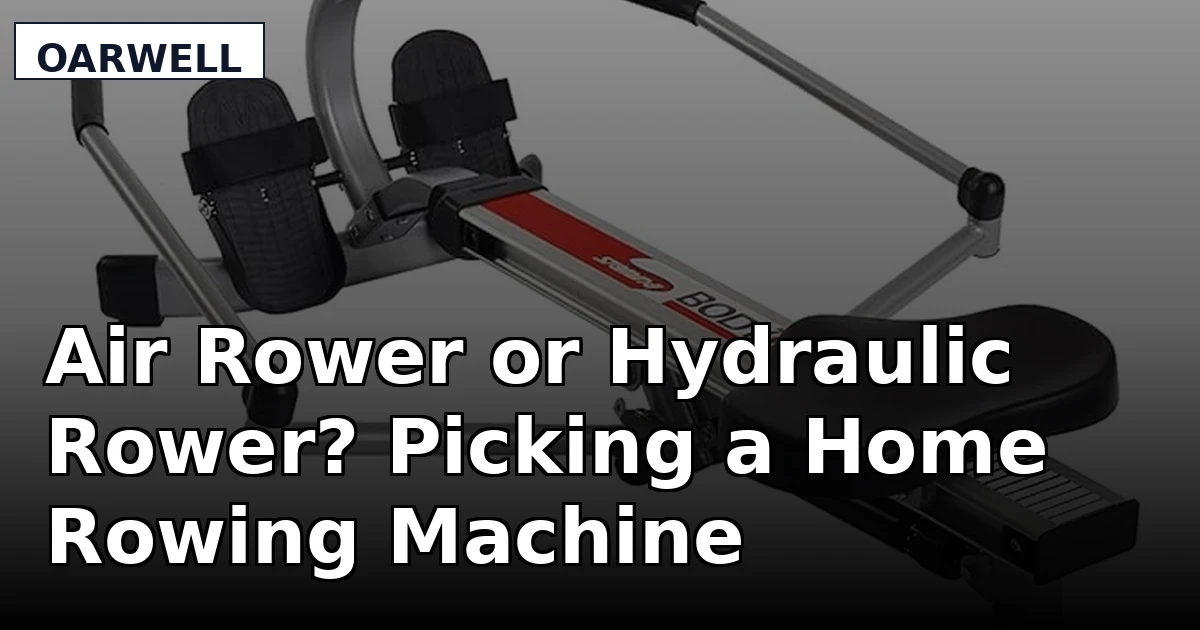
| Stamina Hydraulic Rowing Machine, BodyTrac Glider with Cylinder Resistance, 250 Lbs - Home and Gym Exercise Equipment - Ideal for Fitness Training and Body Workout | Tight spaces and shorter, lighter sessions | Hydraulic cylinder resistance and a 250 lb weight capacity |
| HOW TO USE ADJUSTABLE DUMBBELLS: The Complete Guide To Adjustable Dumbbells: Safety, Workouts, And Lasting Fitness | Rowers adding strength work away from the machine | A written guide covering dumbbell safety, workouts, and long-term programming |
The air rower for most homes: YOSUDA R2 Rowing Machine for Home, Air Rower with Self-Powered Monitor
Air resistance is the reason this is the default recommendation for a home. A fan flywheel gives you resistance that rises with effort, so an easy warmup stroke and a hard interval stroke both feel like the same machine. That consistency is what lets you build fitness on it. It is also the reason an air rower is not the quiet option in the room; the fan makes noise, and you should assume you will hear it from the next room. The self-powered monitor is a practical detail more than a feature: no outlet means no cable running across the floor, which matters in a living room. The trade-off is that air rowers are physically larger than hydraulic machines, and you need rail space behind your heels as well as in front of you.
The foldable air rower: Stamina Elite ATS Air Rower
A folding air rower solves a specific problem: floor space. If the machine has to live against a wall or behind a couch when you are not using it, a fixed frame is a daily argument you will eventually lose. The no-subscription app support is the second useful detail, because it means the connected side of the machine does not add a monthly bill to a piece of equipment you already paid for. The honest caveat about folding rowers is the fold itself. A hinge adds a joint, and joints are where flex and noise show up first. If you buy this style, unfold it fully every time and check that the rail locks tight before you sit down. A folding rower that you stop unfolding is just a heavier rower.
The compact hydraulic option: Stamina Hydraulic Rowing Machine, BodyTrac Glider
Hydraulic resistance is the compromise that buys you space. There is no fan and no long rail, so the machine tucks into a corner that an air rower would never fit into. What you give up is the feel. Hydraulic cylinders create resistance through fluid moving inside a piston, and that resistance does not scale the way a fan does: it is closer to a fixed push and pull with a shorter stroke. Cylinders also warm up as you use them, so the first minute of a session can feel different from the fifteenth. That is not a defect, it is how the mechanism works, and it is why hydraulic rowers suit shorter, lighter, more casual sessions better than long interval work. If you want the smallest possible footprint and you are honest with yourself about how you will use it, this is the category to shop in.
The off-machine companion: HOW TO USE ADJUSTABLE DUMBBELLS
This one is not a rowing machine, and it should not be presented as one. It is in this article because the machine is only part of the workout. Rowing rewards leg drive, hip hinge, and a back that can hold position under load, and those qualities come from strength training as much as from time on the rail. A pair of adjustable dumbbells and a clear plan for using them will do more for your split than another hour of sloppy steady-state. If you already own adjustable dumbbells and use them by feel, this is the structured version. If you do not own them yet, treat it as reading before you buy rather than equipment in itself.
Prices and availability may change. Product images, names, and retailer links must be matched by verified ASIN. Do not state a current price, rating, stock status, or measured result without current evidence.
How air and hydraulic resistance actually differ
Air resistance works through a fan. Every pull spins the flywheel, and the faster the fan spins, the more air it has to move, so the resistance you feel is proportional to the effort you put in. That relationship is why air rowers are the standard for training: the machine does not cap you. A hard ten-stroke sprint feels hard because you made it hard, not because you turned a dial. The same mechanism explains the downsides. A fan moves air, and moving air makes noise. Air rowers also take up a longer footprint because the flywheel housing and rail have to sit in a line.
Hydraulic resistance works through cylinders. You pull against fluid being forced through a valve, and the resistance is largely set by the cylinder rather than by your effort. The result is a shorter, more contained machine that fits in small rooms. The trade is a stroke that does not scale the way a fan does, and a feel that can shift as the cylinder warms during a session. Neither mechanism is fake resistance. They are simply built for different sessions: one for progressive training over months, one for compact, convenient work in a small room.
What the monitor should show, and what to ignore
The monitor matters more than the frame. A well-built machine with a monitor that only shows time and a calorie estimate will not tell you whether you are improving, and a machine you cannot measure is a machine you will eventually stop using. The number that matters is split, the time it takes you to cover 500 meters. It is honest in a way that calories are not, because it is a direct measure of pace and it moves when your fitness moves. Stroke rate is the second number worth watching, since it tells you whether you are rushing the recovery or holding a rhythm you can sustain.
Calorie readouts are the part to ignore. They are estimates built on assumptions about your body and your effort, and they are consistently generous. If you find yourself chasing the calorie number, you are training the monitor rather than yourself. A monitor that shows split, stroke rate, time, and distance is doing its job. A monitor that leads with calories is telling you who the machine was marketed to.
Here is the short version, in order:
- Measure the space, including the rail behind your heels, not just the machine's footprint.
- Decide honestly whether the rower has to fold or stow between sessions.
- Choose the resistance type that matches the sessions you will actually do.
- Check what the monitor displays, and confirm it shows pace rather than only calories.
- Plan your first month of technique before you plan your first interval session.
Practical guidance before you buy
- Sit tall at the catch, drive with your legs first, and let your arms finish the stroke. Form breaks down at the catch and the finish more than anywhere else.
- Treat the damper as a feel setting, not a difficulty setting. Most people set it wrong and then blame the machine.
- Start with 20-minute steady sessions at a stroke rate you can hold. Intervals come after you can repeat a stroke.
- Wipe the rail and check the seat rollers regularly. A squeak or a click is information, not background noise.
- Ignore the calorie number and watch your split over weeks. Pace is the only progress report that does not flatter you.
Which option should you choose?
Choose the YOSUDA R2 Rowing Machine for Home, Air Rower with Self-Powered Monitor when you want air resistance, no power cable, and a machine you plan to train on for years. Choose the Stamina Elite ATS Air Rower when the rower has to fold away between sessions and you want app support without a subscription. Choose the Stamina Hydraulic Rowing Machine, BodyTrac Glider when floor space is the deciding constraint and your sessions will be shorter and lighter. Choose HOW TO USE ADJUSTABLE DUMBBELLS when you want to build the strength and structure around your rowing rather than add another machine to the room.
One caveat before you click anything: this article describes resistance types and product positioning from manufacturer information. It does not report measured noise levels, drag numbers, or durability results for any of these machines, and no machine should be called the quietest, the smoothest, or the best without that evidence. Verify current specifications and dimensions on the listing before you commit, because frames and components change between production runs.
The bottom line
For a home rowing machine, the resistance type decides almost everything that follows: how the stroke feels, how much room you need, how noisy the session is, and how far you can push as your fitness improves. Air resistance is the more trainable mechanism, which is why the YOSUDA R2 and the Stamina Elite ATS are the two to weigh first, with folding as the deciding factor between them. Hydraulic resistance earns its place in small rooms and short sessions, which is where the Stamina BodyTrac Glider fits. The dumbbell guide sits outside that decision entirely, because the machine is only part of the workout and the rest of it happens off the rail. Pick the resistance that matches the sessions you will really do, then spend your first month on technique instead of speed.