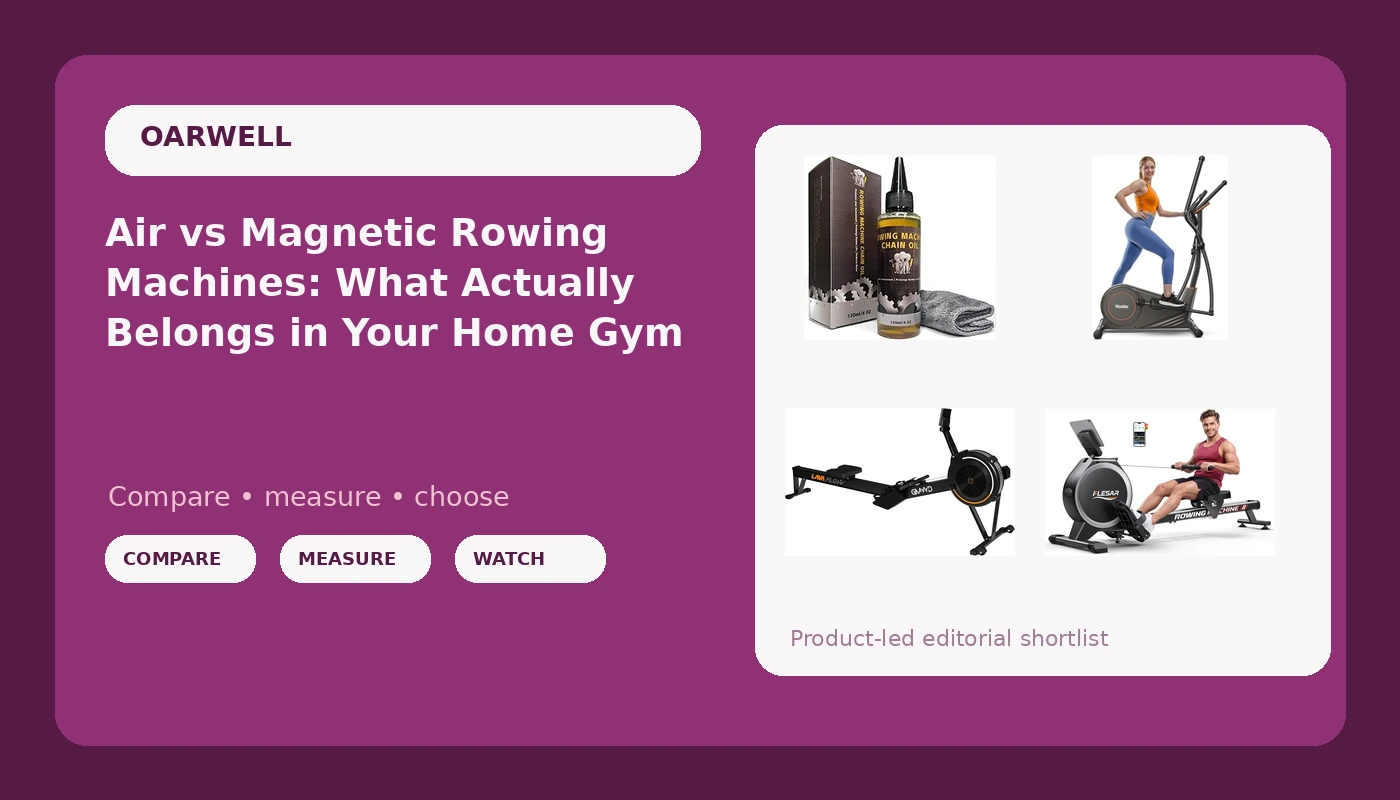
Buying a home rowing machine is mostly a question about resistance, not about brand. The frame, the seat, the monitor, and the rail all matter, but the thing that decides whether you actually use the machine at 6 a.m. is how the stroke feels under load. This explainer covers four options that come up in the same corner of the home gym conversation: two home rowing machines built around different resistance systems, one maintenance product that keeps a chain-drive rower alive, and one low-impact cross trainer that is not a rower at all but can still earn its floor space. The goal is not to crown a winner. The goal is to match a machine to the workout you will genuinely do.
Related: How to Set the Damper on an Air Rower →
Quick answer
Match the resistance type to the room and to the workout. If you want a stroke that carries over to rowing on the water, an air rower is the closer feel, because resistance rises as you push harder. If the machine lives in an apartment or a shared bedroom, a magnetic rower is the practical pick, and the magnetic listing on this page leans on quiet resistance as its main selling point. If you already own a chain-drive rower, the chain oil here is the least expensive way to protect the machine you have. An elliptical is not a rowing substitute, but it can carry low-impact days. Everything below stays within what the product listings state. No price, rating, or measured performance result is claimed here.
4 useful options
| Model | Best fit | What stands out |
|---|---|---|
| GMWD Air Rowing Machine, Lava Flow Series | Rowers who want an air-resistance stroke at home | Listing describes 10-level adjustable resistance and a performance monitor |
| Rowing Machines for Home, Magnetic Rower with 16 Levels | Shared rooms and quieter sessions | Listing describes 16 resistance levels, 350 lb capacity, and a dual slide rail |
| TreadLife Fitness Concept 2 Rowing Machine Chain Oil | Owners of chain-drive rowers | Listing states compatibility with chain-drive rowers, including Concept 2 models A through E |
| Niceday Elliptical Exercise Machine | Low-impact cross training on non-rowing days | Listing describes 15.5 in, 16 in, and 20 in stride options |
The air rower: GMWD Air Rowing Machine, Lava Flow Series
Air resistance works by spinning a fan, which means you set the effort and the machine responds. On this style of rower the lever or dial controls how much air the fan can move rather than a fixed resistance level, so a harder pull meets more resistance and a lighter pull meets less. That is why air rowers feel honest, and it is also why they get loud: the fan noise scales with your effort, so a sprint interval is a noisy interval. When you look at the monitor on a machine like this one, the number worth watching is the split, the time per 500 meters. Calorie estimates are guesses, and they move for reasons that have nothing to do with how well you rowed. Technique note: slow the stroke down, feel the catch, and let the machine do its job while you do yours.
The magnetic rower: Rowing Machines for Home, Magnetic Rower with 16 Levels
Magnetic resistance is the opposite trade. The resistance comes from magnets rather than a fan, so the machine does not get louder as you push harder, and the listing describes quiet resistance across all 16 levels. The trade is feel. Magnetic rowers can feel smooth to the point of vagueness, and the resistance curve does not build the way an air rower's does. That matters less than people think for steady-state work and general conditioning, and more than people think if you are chasing a personal best on a split. The listing also states a 350 lb weight capacity, a dual slide rail, app support, and an LED monitor. Check whether the monitor shows a split rather than only time, distance, and calories, because a monitor that hides your pace turns every session into a guess. Magnetic resistance that feels like stirring soup is a real complaint, and it is worth knowing before you buy, not after.
The maintenance kit: TreadLife Fitness Concept 2 Rowing Machine Chain Oil
Chain-drive rowers need very little, but they need that little consistently. A dry chain wears, a dirty chain drags, and a dragging chain is the difference between a smooth stroke and a stroke that feels like it is fighting you. Treat this as part of the machine's routine rather than a repair. A light application on a clean chain, worked in and then wiped down, is the standard approach: too much oil attracts grit, and grit is what actually kills a chain. If the seat squeaks, the machine is telling you something, so listen before you assume the rail is the problem. A quick wipe of the rail and the seat rollers goes a long way, and it costs nothing.
Prices and availability may change. Product images, names, and retailer links are matched to verified listings. No current price, rating, stock status, or measured result is stated here without current evidence.
The cross trainer: Niceday Elliptical Exercise Machine
What an elliptical can do is take the low-impact cardio days that would otherwise be skipped. Stride length is a fit question more than a feature question. Stride should roughly match your height and hip comfort: too short and the motion feels choppy, too long and you overreach at the front of the pedal stroke. If your goal is to row, spend the floor space on a rower. If your goal is to keep moving on days when your back or knees want something gentler, this is a reasonable second machine, and it will not pretend to be a substitute for a good stroke on an erg.
Air resistance vs magnetic resistance: what actually changes
The resistance system decides almost everything about how a home rower feels, how loud it is, and what kind of training it rewards. Air resistance is self-regulating: the harder you pull, the more resistance you meet, which is why the stroke transfers so well to rowing on the water. The cost is noise, and the noise scales with effort. Magnetic resistance is the opposite: the resistance is set by the machine rather than generated by your pull, so the machine stays quiet even during hard intervals, but the resistance curve is flatter and the stroke can feel less connected.
The second thing that changes is the monitor. A rowing monitor that shows split gives you a pace number you can compare across sessions, and pace is what makes training measurable. Time, distance, and calories are fine as context, but calories in particular are an estimate that moves with body weight and machine settings rather than with how hard you worked. A great frame with a monitor that only reports calories is a frame that will not tell you whether you are improving.
The third is maintenance. Air rowers have a fan and a chain or belt to keep clean. Magnetic rowers have fewer moving parts exposed to sweat and dust. Neither is maintenance free, and neither rewards neglect.
How to read a rowing machine listing
- Start with resistance type, because it decides noise, feel, and the kind of training the machine supports before any other spec matters.
- Look for a pace display. Split, or time per 500 meters, is the number that makes a session measurable across weeks.
- Check the weight capacity and the rail design against the tallest and the shortest person who will use it, not just the heaviest.
- Confirm the seat and footrest adjust enough for your leg length at the catch, which is where most fit problems show up.
- Measure the actual footprint and storage position in your room, including ceiling height if the machine stands upright when stored.
Keeping a home rower working
- Wipe the rail and the seat rollers weekly. Grit on the rail is what makes a seat click and roll unevenly.
- Keep the chain or belt clean, and apply lubricant sparingly rather than generously.
- Set the damper by feel and drag rather than by number, since the same lever position feels different in a cold garage and a warm living room.
- Log split and stroke rate together. Stroke rate without pace tells you nothing about whether you improved.
- Give any machine a full 20-minute session and a set of sprint intervals before you decide you like it, because the first three minutes flatter every rower.
Which option should you choose?
Choose the GMWD Air Rowing Machine, Lava Flow Series when you want the air-resistance stroke and you have a room where noise is not a problem. Choose the Rowing Machines for Home, Magnetic Rower with 16 Levels when the machine shares space with sleeping people or thin walls and you want quiet resistance with app support. Choose the TreadLife Fitness Concept 2 Rowing Machine Chain Oil when you already own a chain-drive rower and want to protect it. Choose the Niceday Elliptical Exercise Machine when you want low-impact cardio on the days you are not rowing.
The limitation worth stating plainly: these recommendations rest on what each listing describes, not on independently measured noise, drag, or durability figures. If a claim is not in the listing, it is not asserted here.
The bottom line
The resistance system is the decision. An air rower gives you the honest, self-regulating stroke that transfers to real rowing, and the GMWD listing pairs that with a performance monitor and a seat built for longer sessions. A magnetic rower trades some stroke feel for quiet operation, and the 16-level listing here is aimed squarely at people who need the machine to disappear into a shared room. A bottle of chain oil is the cheapest insurance an existing chain-drive rower can get. And an elliptical belongs on this list only as a complement, useful on the days when rowing is not what your body wants. Pick the machine you will use on a Tuesday in February, not the one that looks best in a product photo.