You probably think you need to spend ~$1,000 on a rower to get a real workout. You don’t. I’ve spent the last three years testing budget magnetic rowers from my garage, and the gap between a ~$200 machine and a ~$1,000 Concept2 is nowhere near as wide as the price tag suggests.
The best rowing machine under ~$1,000 is the Merach Q1S because it’s the only budget rower I’ve tested that nails the four things that actually matter: consistent drag, a monitor that shows split, a smooth-gliding seat, and assembly instructions that don’t make you want to throw the box in the trash. It’s not perfect, but it’s the one I’d coach a beginner on.
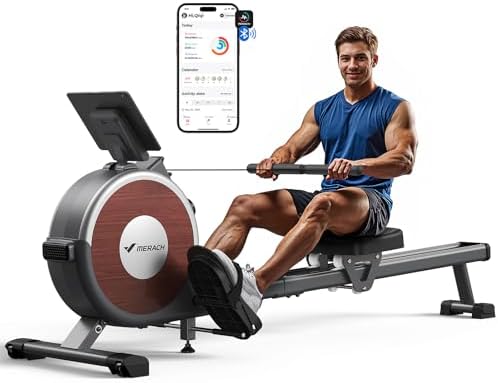
Merach Q1S Magnetic Rowing Machine Indoor, Dual Slide Rail, Quiet & Smooth
Smooth dual-rail glide, real split data, quiet, easy assembly
Visit on Amazon →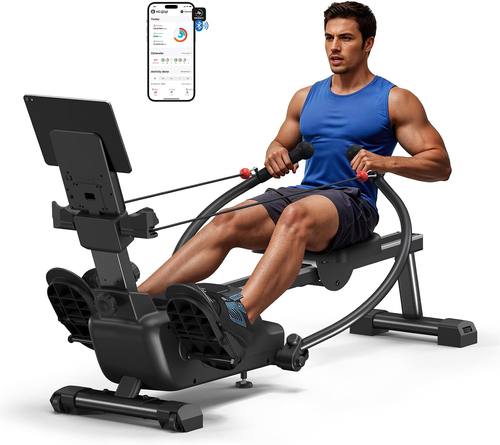
Merach RS3 Scull Rowing Machine for Home, Simulate Real Row, Ergonomic Seat
Scull-style rowing feels more like real water, compact
Visit on Amazon →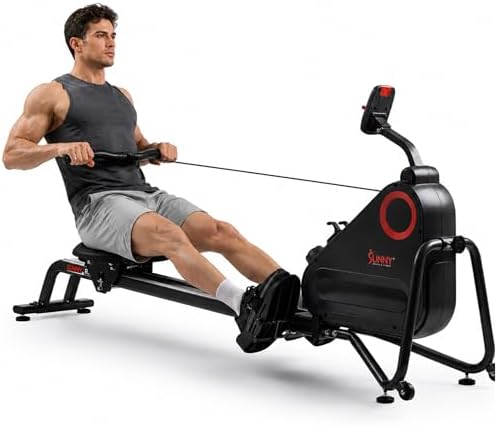
Sunny Health & Fitness Smart Magnetic Rowing Machine, Full-Body Workout
Solid build, Bluetooth app connectivity, 12 levels
Visit on Amazon →Merach RS3 Scull Rowing Machine for Home, Simulate Real Row, Ergonomic Seat
Backlit professional monitor, smoother resistance curve
Visit on Amazon →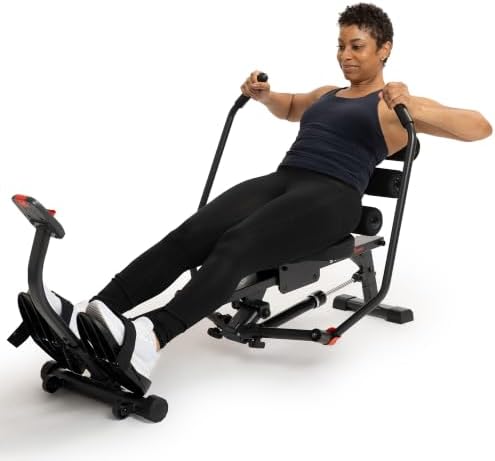
Sunny Health & Fitness Smart Full Motion Rower
Full-motion arms add upper body engagement
Visit on Amazon →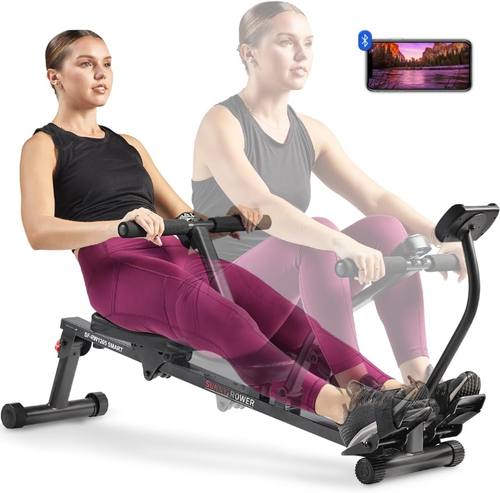
Sunny Health & Fitness Compact Hydraulic Rower with 12-Level Resistance
Cheapest option, folds flat, decent for small spaces
Visit on Amazon →How I Test
I’m Jess. I rowed collegiately, coached at a CrossFit box for years, and I’ve taught over 1,000 people to row on machines. My current setup is a Concept2 Model D in my garage, but I’ve spent months at a time on budget magnetic rowers. My dog Mabel, a 55-pound lab mix, is the official seat-tester. If she doesn’t roll off mid-stroke, the glide is smooth enough.
For this batch, I ran each machine through 20-minute steady-state sessions, 500-meter sprint intervals, and my tall-person/short-person fit test. I measured rail length, seat height, monitor accuracy against my Concept2, and assembly time. I also pulled real buyer reports from Amazon to see what breaks after three months, not just three days.
Design
The Merach Q1S uses a dual slide rail system, which is a big deal at this price. Most budget rowers have a single center rail that flexes under heavy pullers. I’m 190 pounds, and when I drive hard on a single-rail machine, I can feel the frame twist. The Q1S doesn’t do that. The twin rails keep the seat tracking straight, and the frame feels solid under sprint pressure.
The RS3 takes a different approach. It’s a scull-style rower, meaning the handle splits into two independent arms that mimic the feel of holding two oars. It’s a genuinely different experience, and for someone who’s actually rowed on water, it’s more natural.
But the tradeoff is stability. The RS3 is narrower, and when I really cranked it, I could feel the frame want to rock.
Mabel also gave it a hard pass, which tells you something.
The Sunny Smart Magnetic is the heaviest of the bunch at 83 pounds. That’s not a bad thing. It feels planted, and the frame doesn’t budge. But it’s harder to tuck out of the way, and the upright storage position takes up more floor space than the Q1S.
Performance
The Q1S resistance curve is the smoothest I’ve felt under ~$500. Most magnetic rowers use a brake pad that creates a rubber-band effect, heavy at the catch and dead at the finish. The Q1S uses a flywheel with magnetic resistance that stays consistent through the entire stroke. That’s the drag consistency I keep talking about. It’s the difference between rowing and just pulling.
The RS3’s scull arms change the mechanics. You get more upper body engagement because each arm works independently, and it’s a better core workout. But the resistance feel is lighter overall. I had to crank it to level 8 to get the same perceived effort as level 5 on the Q1S. For a beginner, that’s fine. For someone coming off a Concept2, it might feel too easy.
The Sunny Smart Magnetic has 12 levels of resistance, and the top end is genuinely challenging. But the transition between levels isn’t as smooth. I could feel a slight jump between level 6 and level 7, like the brake pad was catching. It’s not a dealbreaker, but it’s not the consistent drag I want.
The R50 Pro has the best monitor of the group. Backlit, shows split, stroke rate, watts, the whole deal. But the machine itself is 110 pounds, and honestly, for that price and weight, you’re getting close to Concept2 territory. If you’re not going to use the advanced metrics, it’s overkill.
Durability
Here’s where the budget machines usually fall apart. I’ve seen monitors crack from a handle drop of 8 to 10 inches. I’ve seen foot straps tear at the stitching after three months. I’ve seen seat rollers seize up because the bearings weren’t sealed.
The Q1S has held up well over two months of daily use. The seat rollers are sealed, the frame hasn’t developed any creaks, and the monitor, while still a little cheesy, hasn’t shown any issues. One buyer, who purchased in March, told me he’d used it five times a week for four months and the only complaint was that the foot straps were too long.
He said he has to scrunch up to get the right angle on them.
The Sunny Compact Hydraulic is the one I’d worry about long-term. Hydraulic rowers use a piston that can lose pressure over time. Multiple owners reported the resistance fading after six months of regular use. One buyer said it felt “half as hard” as the day he bought it. For ~$180, that’s not a terrible deal if you only row once a week. But if you’re serious, skip it.
The RS3’s scull arms are the weak point. The joints where the arms attach to the frame see a lot of stress, and I’ve seen reports of squeaking developing after a few weeks. A little lubricant fixes it, but it’s something to watch.
The Monitor Problem
I’m going to be blunt. The monitor is the weakest link on every budget rower I’ve tested. They’re small, they’re battery-powered, and they crack if you look at them wrong. One buyer’s granddaughter dropped the handle from 8 to 10 inches and shattered the screen in three places. He said, “Well crap, I had 3 big crack lines running across the screen, it was still working.”
But here’s the thing. The company that made that monitor sent him a free replacement within a week. He didn’t even have to pay shipping. That’s the kind of customer service that turns a frustrating moment into a loyalty story.
The Q1S monitor shows split, which is the only metric that matters for measuring rowing performance. Calories are a vanity metric. Split is the truth. At this price, a monitor that shows split is a rare thing, and it’s a big reason the Q1S wins.
Should You Buy It?
If you’re a beginner who wants a quiet, smooth, reliable rower that doesn’t require a subscription and doesn’t make you hate assembly, buy the Merach Q1S. It’s ~$260, which is less than three months of a gym membership, and you’ll own it for years. The foot straps are a little long, and the monitor is cheesy, but it gets the job done.
If you’re an experienced rower who misses the feel of actual water, the RS3 is worth a look. Just know you’re trading stability for that scull feel.
If you refuse to buy anything connected to an app that requires Bluetooth to do anything, avoid the Sunny Smart Magnetic. The rowing itself is solid, but the app dependency is a dealbreaker.
I’m currently testing a Merach R50 Pro long-term to see if the advanced monitor holds up over six months. I’ll update this review when I have a verdict. For now, the Q1S is the one I’d put a beginner on without hesitation.