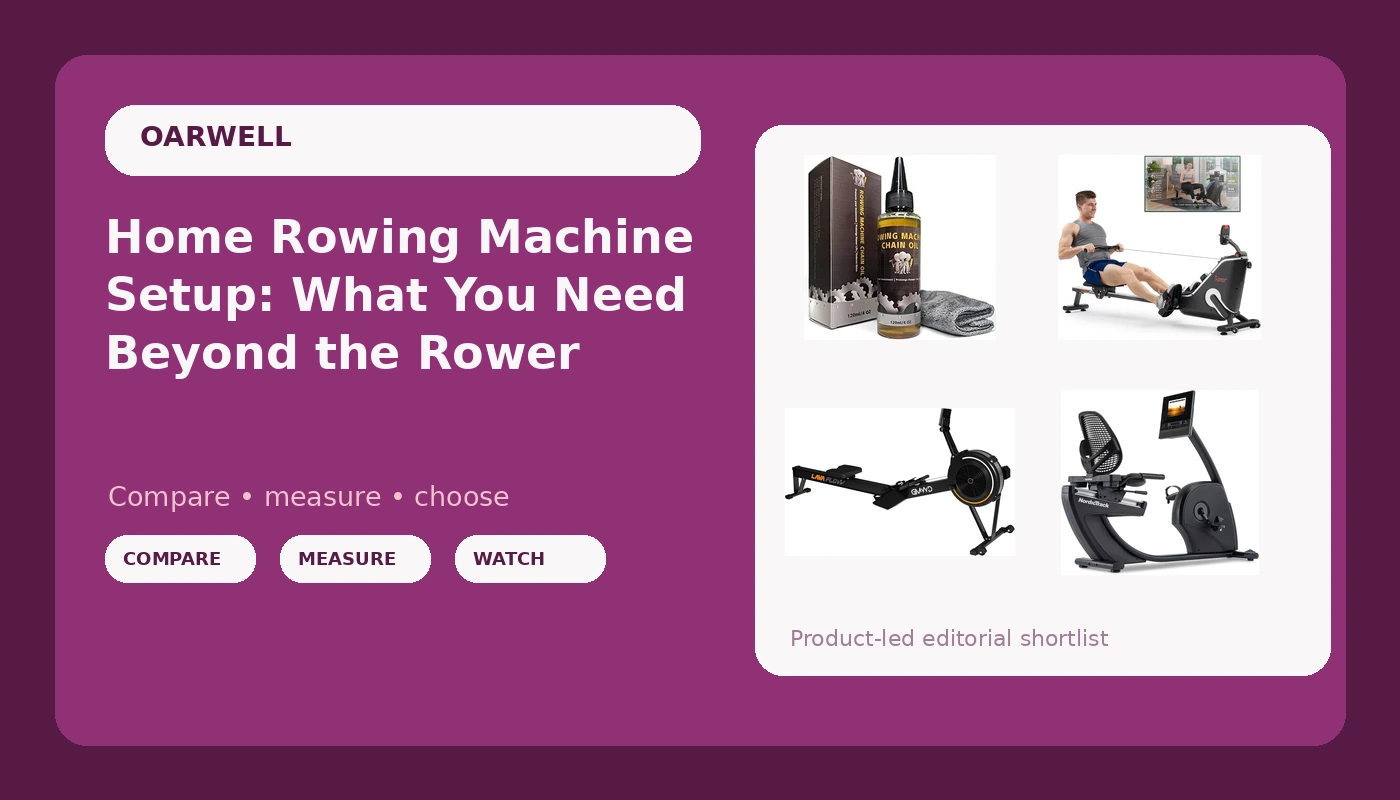
A home rowing machine setup is rarely one purchase. You pick the machine, you find a place to put it, and then you learn that the machine has needs of its own: a chain that wants oil, a rail that wants to stay clean, a seat that tells you when something has worked loose. The four items below cover the range most people actually run into: an air rower, a compact magnetic rower, a bottle of chain oil for chain-drive machines, and one non-rowing option for the days when your back or knees want something different. None of them is a magic purchase, and none of them fixes a stroke you have not learned yet. Each one answers a different question, and the order you should think about them in is not the order most people buy them in.
Related: How to Set the Damper on an Air Rower Without Guessing →
Quick answer
Match the machine to the resistance type you will actually tolerate, then budget for upkeep. An air rower gives you the stroke feel that transfers to a real boat and to the chain-drive machines you will meet in a gym. A magnetic rower gives you a compact machine with no fan, and the fan is where most of an air rower's noise comes from. Chain oil keeps a chain-drive machine from rusting into a rough, draggy catch. A recumbent bike is the honest answer on days when you want steady cardio without a rowing stroke, and it is a separate machine rather than a rowing accessory. Nothing here is a substitute for learning the stroke sequence, because the machine is a small part of the workout and your technique is the rest of it.
Four useful options
| Model | Best fit | What stands out |
|---|---|---|
| GMWD Air Rowing Machines for Home, 10-Level Adjustable Resistance Professional Rower Machine with Performance Monitor, Ergonomic Comfort Seat, Device Holder & Easy Storage, Lava Flow Series | Home rowers who want an air-resistance stroke | 10-level adjustable resistance, a performance monitor, a device holder, and easy storage |
| Sunny Health & Fitness Smart Flippable Magnetic Rower, 50 Inches Quiet & Smooth Stainless Steel Slide Rail, Full-Body Low-Impact Exercise Rowing Machine For Home, Free SunnyFit Training APP Connection | Small rooms and lighter steady sessions | Flippable design, a 50 inch stainless steel slide rail, and a free SunnyFit app connection |
| TreadLife Fitness Concept 2 Rowing Machine Chain Oil | Anyone keeping a chain-drive rower alive | Lubricates and protects against rust and dirt, with stated compatibility across chain-drive rowers |
| NordicTrack 10 Recumbent Bike | Low-impact cardio on non-rowing days | A recumbent seating position and a movement pattern that does not require a rowing stroke |
The air rower: GMWD Air Rowing Machines for Home, 10-Level Adjustable Resistance Professional Rower Machine with Performance Monitor, Ergonomic Comfort Seat, Device Holder & Easy Storage, Lava Flow Series
Air resistance is the reason this is the first machine in the list. With a fan, the harder you pull, the more resistance you meet, which is the same relationship you feel in a boat and on the chain-drive ergs in most gyms. That relationship is what makes an air rower worth the space. It also means the machine gets louder the harder you go, because the fan is the sound, and it means the flywheel housing will collect dust over time.
The trade-off is the monitor. A performance monitor on an air rower is only useful if it shows a split, meaning time per 500 meters, rather than just elapsed time and an estimated calorie number. Split is the honest pace figure, and it is the number that lets you compare one session to the next. If the monitor leads with calories, ignore that field and work from the split instead. As for the resistance setting, treat the ten levels the way you would treat a damper lever: it changes the feel of the drive, not the fitness you get out of it, and most people run it heavier than they should. Set it where you can hold your technique at the catch and the finish, then leave it alone.
The compact magnetic option: Sunny Health & Fitness Smart Flippable Magnetic Rower, 50 Inches Quiet & Smooth Stainless Steel Slide Rail, Full-Body Low-Impact Exercise Rowing Machine For Home, Free SunnyFit Training APP Connection
The flippable frame is the point of this machine. If your apartment has a hallway worth of floor space and nothing else, a rower that stands up out of the way is the difference between a machine you use and a machine you trip over. The 50 inch stainless steel rail is also a real specification rather than a marketing phrase, and rail length is one of the few numbers that actually determines whether a machine fits you, which I will come back to.
Magnetic resistance feels different, and you should know how before you buy. There is no fan, so the resistance comes from magnets rather than from the air you are pushing, which means the drive feels smoother and more even from the catch to the finish. That evenness is pleasant for steady work at a conversational pace. It is also why magnetic rowers can feel like stirring soup when you try to sprint, because the resistance does not build the way it does with a fan. The listing describes the rail as quiet and smooth, and it is fair to say that removing the fan removes the biggest noise source on a rower, but I have no decibel reading for this machine and neither does the listing, so treat quiet as relative rather than absolute. The seat rollers and the rail are what will make the noise anyway, and a clean rail is the fix.
The maintenance piece: TreadLife Fitness Concept 2 Rowing Machine Chain Oil | Lubricates and Protects Rower from Rust & Dirt | Compatible with All Chain-Drive Rowers, Including Concept 2 Models A B C D E
This is the least exciting item here and the one that decides how long a chain-drive machine lasts. A dry chain wears, a dirty chain drags, and both show up in the same place: the catch, where the drive suddenly feels rough instead of smooth. Rust is worse, because it pits the links and no amount of oil puts the metal back. If you own a chain-drive rower, oil is a consumable the same way shoes are, and the cost is trivial next to the machine.
Two practical notes. First, the manufacturer's manual for your specific rower is the authority on how often to oil the chain and how much to apply, so follow that rather than a number from a blog. Second, the environment matters more than the calendar. A machine in a humid garage or a dusty basement needs attention more often than one in a climate-controlled room, and a chain that has been sitting unused for a season deserves a look before you pull hard on it. The listing states compatibility with chain-drive rowers generally, including the Concept 2 model range, so if you already own a chain-drive machine this is a low-risk purchase. If you own a magnetic or water rower, this does nothing for you.
The cross-training alternative: NordicTrack 10 Recumbent Bike
I am including a recumbent bike in a rowing article on purpose, because the most common failure I see in home setups is a machine that only does one thing and only gets used when the buyer feels good. A recumbent bike asks nothing of your technique. You sit down, you pedal, you stop. That makes it useful for the days when your lower back is unhappy, when you want twenty minutes of easy movement while watching something, or when a beginner in the house is not ready to think about the catch and the finish. It is not a rower and it will not train a rowing stroke, so do not buy it as a substitute for one. It is the second machine, the one that keeps the habit alive when the first machine is not what you want that day. Be honest about whether you have room and budget for two machines before you go this route.
Prices and availability may change. Product images, names, and retailer links are matched to verified listings. No current price, rating, stock status, or measured result is stated here without current evidence.
Why resistance type decides more than the frame
Most shopping questions about rowers are really questions about resistance. Air rowers use a fan, so the resistance rises with how hard you pull, the drive feels connected from the catch to the finish, and the machine makes noise in proportion to your effort. Magnetic rowers use magnets, so the resistance is smooth and consistent, the machine stays compact, and sprint work feels flatter because the resistance does not build with your effort. Water rowers use a tank, and they feel closest to a boat, but the tank is a maintenance project with water treatment and seals to think about. Hydraulic rowers are a category to skip.
The frame matters less than the resistance type, but two frame numbers matter a lot. Rail length determines how far the seat can travel, which determines whether a tall rower can reach full extension at the finish or a shorter rower has to reach too far forward at the catch. Foot stretcher position matters just as much, and it is adjustable on most machines: the strap should cross the widest part of your foot, roughly where the ball of your foot sits, so your heel can lift naturally through the drive. Get those two things wrong and no amount of good resistance saves the workout.
The third variable is the monitor, and this is where cheap machines give themselves away. A monitor that shows split, meaning time per 500 meters, is a training tool. A monitor that shows only time and a calorie estimate is a decoration, because calorie estimates on rowing machines are generous guesses that vary with body weight and technique. If the monitor cannot show you a split, you are rowing blind, and you will have no idea whether the session you just did was harder or easier than the one last week.
Setup, storage, and the upkeep that decides how long the machine lasts
Once the machine is home, the work shifts to the room and the parts that wear. Five decisions in order:
- Measure the floor space twice, once for the machine in use and once for the machine in storage, because a rower that cannot be put away will live in the middle of the room.
- Choose the resistance type based on how hard you will actually pull, not on how hard you intend to pull in January.
- Confirm the rail length and seat height in the specifications against your own height before you buy, especially if you are tall or short.
- Check that the monitor shows split per 500 meters, since that is the number that makes training comparable week to week.
- Budget for consumables, meaning chain oil for a chain-drive machine and a plan for keeping the rail clean on any machine.
Practical guidance that applies to every machine
- Set the foot stretcher first. The strap should cross the ball of your foot, and your heel should be able to lift through the drive.
- Learn the sequence before you chase pace: legs, then back, then arms on the drive, and arms, then back, then legs on the recovery.
- Row rate before pace. Twenty to twenty-four strokes per minute is plenty for steady work, and slowing the stroke down is what exposes a form problem.
- Keep the rail clean. A gritty rail sounds like a broken machine, and a wipe with a damp cloth fixes it.
- Oil a chain-drive chain on the schedule your machine's manual gives, and more often in a humid or dusty space.
Which option should you choose?
Choose the GMWD Air Rowing Machines for Home, 10-Level Adjustable Resistance Professional Rower Machine with Performance Monitor, Ergonomic Comfort Seat, Device Holder & Easy Storage, Lava Flow Series when you want the resistance feel that transfers to a boat and to gym ergs, and you have room for a machine that stays set up. Choose the Sunny Health & Fitness Smart Flippable Magnetic Rower, 50 Inches Quiet & Smooth Stainless Steel Slide Rail, Full-Body Low-Impact Exercise Rowing Machine For Home, Free SunnyFit Training APP Connection when space is the constraint and your sessions are steady rather than maximal. Choose the TreadLife Fitness Concept 2 Rowing Machine Chain Oil | Lubricates and Protects Rower from Rust & Dirt | Compatible with All Chain-Drive Rowers, Including Concept 2 Models A B C D E when you already own a chain-drive rower and want to keep it out of the repair category. Choose the NordicTrack 10 Recumbent Bike when you want a second, technique-free machine for low-impact days.
One caveat on evidence. Nothing here rests on a decibel reading, an independent monitor test, or a measured resistance curve, because none of those are available for these listings, and quiet claims on a product page should be read as marketing rather than measurement. Check the specifications on the listing for the numbers that matter to your body: rail length, seat height, machine footprint, and monitor fields.
The bottom line
Build the setup in the order that the problems actually arrive. Pick the resistance type that matches the work you will do, confirm the rail and the foot stretcher fit your body, make sure the monitor can show you a split, and then keep the machine clean and oiled. An air rower, a compact magnetic rower, a bottle of chain oil, and a recumbent bike for the off days cover the whole range of home rowing decisions without pretending any one of them is the answer for everybody.