I have taught more than a thousand people to row, first at a college boathouse and later in a CrossFit box and a dedicated rowing studio in Seattle, and the question that follows me everywhere is which home rowing machine is worth the floor space. So this is the comparison I wish brands would publish themselves: four home rowing machines, sorted by what they actually do for your training rather than by what the marketing copy says.
The short version is that home rowing machines fall into two families. Air rowers, where a fan provides the resistance, feel like rowing and get honest with you fast when your form slips. Magnetic rowers, where magnets provide the resistance, feel smoother and quieter and are more forgiving of a lazy stroke. Neither is a scam. They serve different people, and the four machines below cover both sides of that line plus one that imitates a scull.
I buy on the same principle I coach on: you are not buying a rowing machine, you are buying the workouts you will actually do on it. A machine that lives folded under a bed gets used zero times. A machine you can see from the couch gets used on the nights you do not feel like training, and those nights are the entire game.
Related: Indoor Rowing Technique: Fix Your Catch And Finish
The best home rowing machine for most people is the Concept2 RowErg, because the PM5 monitor and the air resistance teach you to row instead of just letting you pull. If quiet operation and a smaller footprint are hard requirements, the Merach Q1S is the magnetic machine I would point you toward. If you want the closest thing to a boat in your living room, the Merach RS3 is the interesting one. And if you want the cheapest way onto a rower for occasional use, the Sunny Health & Fitness SF-RW5864 is fine, and I mean occasional.
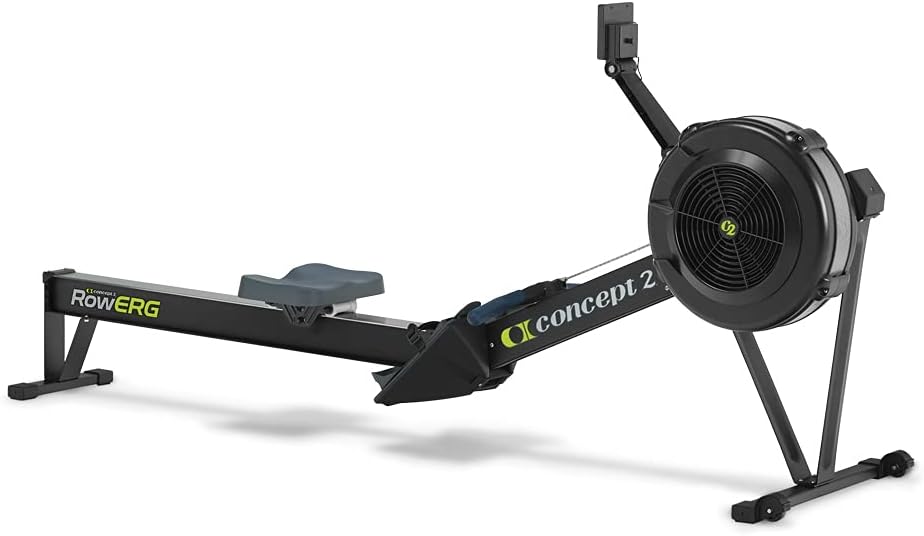
Concept2 RowErg Indoor Rowing Machine
Air resistance answers to how hard you drive, the PM5 gives you pace and split, the device holder is genuinely useful, and it stores by splitting in two
It costs the most here, takes the most floor space, and the fan is not a quiet machine in a thin-walled apartment
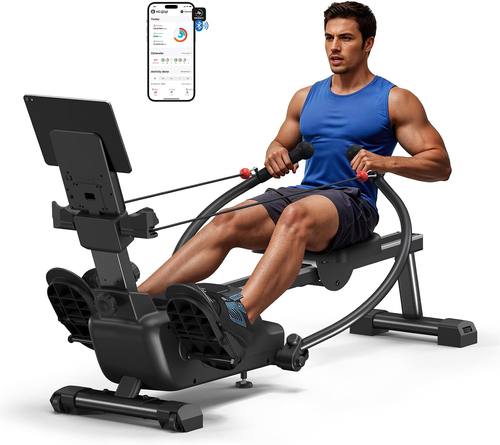
Merach RS3 Scull Rowing Machine for Home
The scull-style pull simulates a real row better than a standard handle, and the ergonomic seat is built for longer sessions
Magnetic resistance still feels flatter through the stroke than air, and the monitor is not a training tool the way a PM5 is
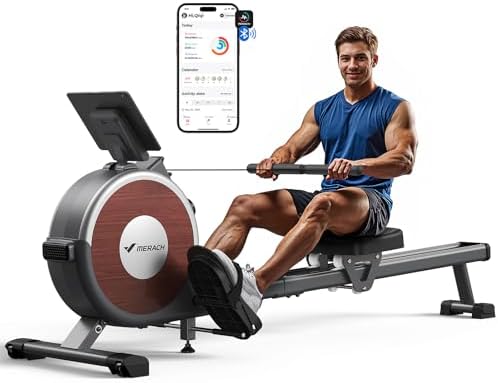
Merach Q1S Magnetic Rowing Machine Indoor
Dual slide rail keeps the seat tracking straight, and quiet, smooth operation is the whole reason to go magnetic
Resistance does not scale with effort the way air does, so hard intervals have a ceiling
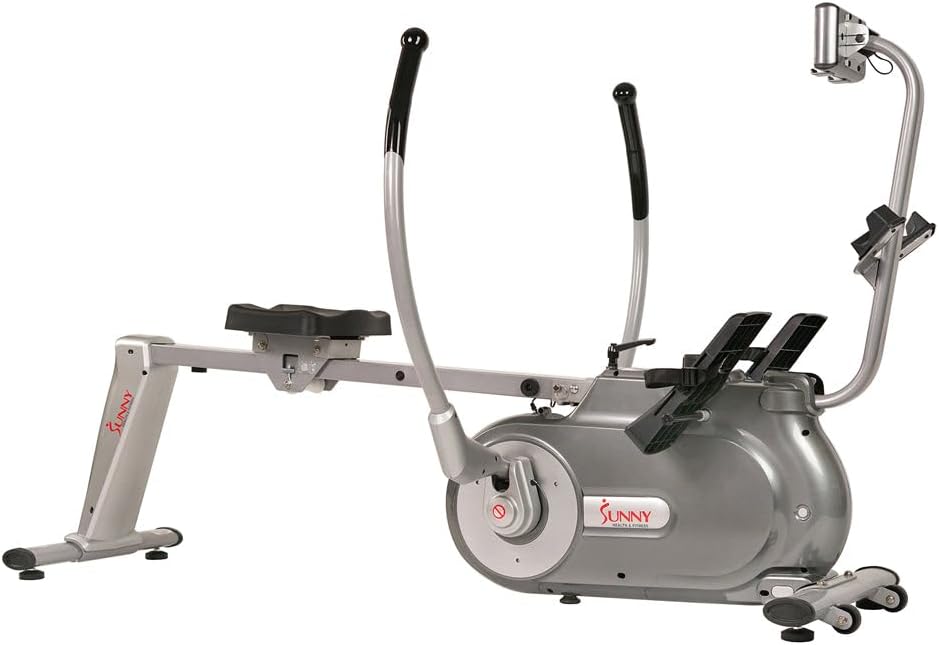
Sunny Health & Fitness Full Motion Magnetic Rowing Machine SF-RW5864
Full motion arms, an elevated seat, a 265 lb max weight rating, and a frame that folds
Foldable frames at this end of the market flex, and an elevated seat changes your geometry in ways your lower back will notice
Prices and availability were captured from Amazon Creators API and may change.
How I judge a rowing machine before I recommend it
Four questions decide almost everything for me, and they have nothing to do with how a machine looks in a product photo.
- Does the resistance feel consistent from the catch through the finish, or does it surge and fade?
- Does the monitor show split, meaning time per 500 meters, or does it only show calories and a stroke counter?
- Does the seat roll smoothly and quietly along the rail, or does it click and hitch?
- Would I put a beginner on it for their first twenty minutes without apologizing first?
The monitor question is the one people ignore and regret. A great frame with a dumb monitor becomes a clothes rack, because a rower without honest pace feedback is just a chair with a handle. The seat question is the one that breaks the deal later. If the seat squeaks on day three, the machine is telling you something about the rail, the rollers, or the frame alignment, and it does not usually get better.
One thing I will not do here is hand you a decibel number. I do not have a clean meter reading from every machine in this comparison in front of me, and I would rather say nothing than quote a figure I cannot stand behind. What I can say is structural: there is no fan on a magnetic machine, so there is less mechanical noise by design. That is the reason the Q1S and the Sunny exist as apartment machines.
Concept2 RowErg: the machine that sets the standard
The RowErg is the machine I recommend without caveats, and I say that as someone who has spent years defending that position to people who think a cheaper rower does the same job. It does not, and the difference is not the frame. It is the combination of air resistance and the PM5.
Air resistance is self-regulating in a way magnets cannot match. Pull harder and the fan pushes back harder. Pull easy and it lets you coast. That feedback loop is what makes an air rower a coaching tool: the machine rewards a strong drive and exposes a weak one, which is exactly what you want when you are learning, because the erg does not lie.
The PM5 is the other half of the argument. It shows split, it holds the pace data you need to run intervals, and it has a device holder so you can prop a phone or tablet without duct tape. If you care about stroke rate work, interval programming, or comparing your numbers to anyone else's, this is the monitor that makes it possible, and the community around it is part of why the resale value holds up.
Technique note: most people set the damper wrong. The damper is a lever, not a resistance dial, and cranking it to ten does not make you stronger, it just makes the flywheel heavy and your stroke slow. Set it in the middle, then learn to feel the drag factor, which is the honest resistance number. A quick catch and a long, patient drive beat a hard yank every time.
Where it loses: price, footprint, and volume. It is the most expensive machine here, it wants a permanent spot on the floor even though it splits in two for storage, and the fan makes noise. In a thin-walled apartment at 6 a.m., that noise is a real cost.
Merach RS3 Scull: the closest thing to a boat on land
The RS3 is the machine in this group I find most interesting, because it is trying to solve a specific problem: a standard rowing handle gives you one grip and one path, while a scull gives you two handles that move independently. The RS3 is built around that idea of simulating a real row, and the ergonomic seat suggests the designers expect you to sit on it for a while.
For someone who has rowed on the water and misses it, that scull feel matters more than any spec sheet number. Two handles let your shoulders and wrists work the way they do in a boat, and it makes the machine feel less like a gym appliance.
Technique note: independent handles expose asymmetry fast. If your left arm is doing less work than your right, you will feel it on this machine within a few strokes, which is either a feature or a wake-up call depending on your ego. Keep your hands level through the drive and do not let one handle drift ahead of the other.
Where it loses: the resistance. Magnetic resistance does not build the same way air does through the drive, so the stroke feels flatter, and the monitor is not going to replace a PM5 for anyone training seriously. Buy it for the feel, not for the numbers.
Merach Q1S: the apartment compromise
The Q1S is the machine I would suggest to a neighbor in a condo who wants to row without becoming the person everyone in the building knows by sound. The dual slide rail is the detail I like most here. Two rails keep the seat tracking straight, which reduces the side-to-side wobble you get on single-rail budget frames, and a straight seat path means your stroke stays honest.
It is marketed as quiet and smooth, and that is the honest promise of magnetic resistance: no fan, less mechanical noise, a smoother pull. For low-impact steady sessions, that is a legitimate training tool. If you are coming back from an injury, or you want twenty minutes of easy aerobic work while a podcast runs, the Q1S does the job without drama.
Technique note: magnetic machines let you get away with a soft catch, so you have to police your own form. Do not let the smoothness turn your stroke into a slow pull with your arms. Legs first, then the body swing, then the arms, and reverse it on the recovery.
Where it loses: the ceiling. Because the resistance does not scale with how hard you drive, sprint intervals top out early. You can do them, but the machine will not fight back the way an air rower does, and if your goal is a faster 2K, that gap matters.
Sunny Health & Fitness SF-RW5864: full motion magnetic, folding frame
The SF-RW5864 is the value pick, and I want to be careful about what that means. Full motion arms, an advanced LCD display, an elevated seat, a 265 lb max weight rating, and a foldable frame are a lot of features for the money. If you want a rower for occasional use, for a spare room, or for a family member who wants low-impact cardio a few times a week, this is a reasonable place to land.
The elevated seat is the detail to think about. Sitting higher changes the angle of your drive and your finish, and it can be kinder to knees and hips for some people while being harder on the lower back for others. If you have any history of back trouble, sit on one before you commit.
Technique note: on a full motion machine, resist the urge to turn the stroke into a rowing-like arm pull. The arms follow the legs and the body, not the other way around. Slow the stroke down to a pace you can hold for twenty minutes and let the machine do its job.
Where it loses: flex and folding. Cheap folding frames move under load, and a rail that flexes will drive you crazy within a month. The irony of folding rowers is that most of them fold once and never unfold again, which means you paid for a hinge you do not use. This is a fine machine for occasional use. It is not the machine you buy to train for a 2K.
The trade-offs that actually decide it
- Resistance feel: air resistance responds to effort and teaches pace. Magnetic resistance is smoother, quieter, and does not scale the same way. If you want to get fitter at rowing, air wins. If you want to move your body quietly, magnetic wins.
- Monitor: the PM5 is a training instrument that shows split and pace data. The LCD displays on the magnetic machines are fine for time, count, and a rough sense of output, and that is the honest limit.
- Footprint and storage: the Concept2 splits in two and stands up. The magnetic machines are generally lighter and easier to move, and the Sunny folds. Do not buy storage you will not use.
- Noise: no fan means less mechanical noise. That is the design logic, and it is the main reason to choose magnetic in a shared building.
- Maintenance: air rowers want the fan housing and chain kept clean, magnetic machines have less to maintain. Neither is a water tank, which is a maintenance project of its own.
- Resale: the Concept2 holds value because the community around it keeps demand steady. The budget magnetic machines are harder to sell used.
- Ceiling: if you plan to do sprint intervals and chase a faster split, only one machine in this group will keep pushing back after month three.
A technique note before you buy any of them
The machine is about twenty percent of your workout. The other eighty percent is what you do on it, and no purchase fixes a stroke that breaks down at the catch.
Slow the stroke down. Most beginners row at a rate that feels athletic and produces almost no useful work. Aim for a rhythm you can hold for twenty minutes, with a quick catch, a long drive, and a recovery that takes roughly twice as long as the drive. Feel the catch, feel the finish, and let the machine do its job while you do yours. If you want one number to watch, make it split, not calories. The calorie readout on any monitor is a guess, and chasing it is how people learn to row badly.
Which one I would buy
If you are buying one machine and you want it to last a decade, get the Concept2 RowErg. It is the standard for a reason, and the resale value is the proof.
If you live above someone and you know a fan will end the hobby, get the Merach Q1S. The dual slide rail and the quiet magnetic pull are the point, and you will actually use it at 6 a.m.
If you have rowed on the water and you miss the feel of two handles, the Merach RS3 is the one worth trying. Buy it for the stroke, not the screen.
If your budget is tight and your ambition is a few easy sessions a week, the Sunny Health & Fitness SF-RW5864 will do that job, and only that job. Be honest with yourself about which rower you are.
What I am testing next
I am in the middle of a longer stretch of interval work, comparing how each resistance type behaves when you ask it for a hard twenty strokes, because that is where cheap machines reveal themselves. The pattern I keep seeing is that the frame is rarely the problem. The resistance and the monitor are. I will report back with the maintenance log.