Most people building a home rowing setup spend every hour of research on the machine and almost none on the system around it. That order is backwards. The rower is the engine, but the setup decides whether you climb on it on a Tuesday night in February or let it gather dust while the rail collects laundry.
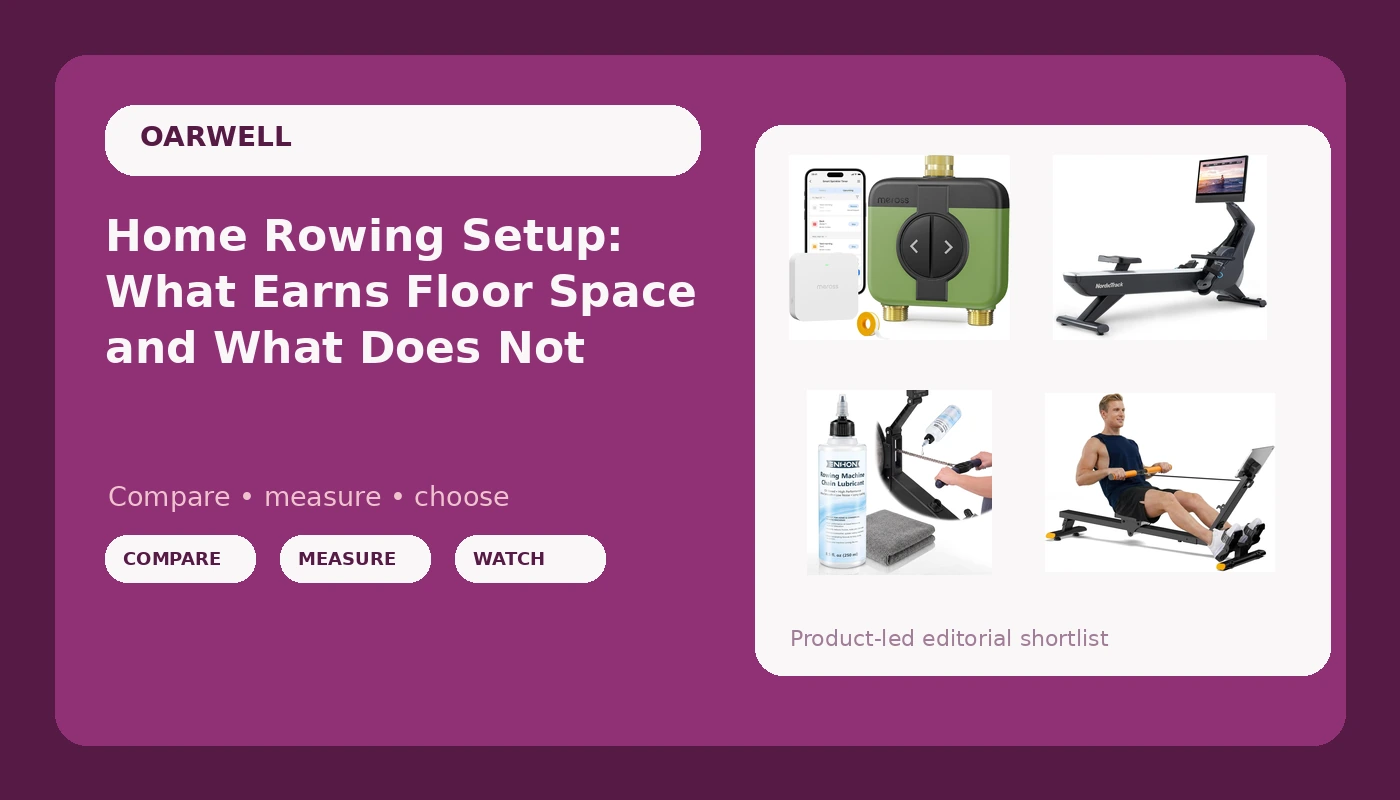
This explainer walks through four items from this month's gear list: two very different rowers, a small care kit for chain-driven machines, and one item that has no business in a rowing article at all. Rather than pretend all four belong in the same category, I will say plainly what each one is for, where each one stops being useful, and how to think about the choice if you are assembling a home gym this year.
Related: Damper, Drag Factor, and Why Your Split Is the Only Number That Matters →
Quick answer
Match the machine to how you will actually train, then let everything else support that machine. If you want guided, screen-driven sessions, the NordicTrack RW900 Rower is the item here built around that idea, with the honest caveat that the subscription feeding the screen is a recurring cost to price out before you buy. If you want the lowest-cost way to do occasional steady-state work, the budget magnetic rower in this list is the entry point, and its listing's capacity and quiet-resistance wording deserves a careful read rather than blind trust. If you already own a chain-driven air rower, the Enhon chain oil kit is maintenance, not an upgrade. And the meross hose timer is not rowing equipment, so I will cover it honestly at the end instead of forcing it into a category it does not fit.
Four useful options
| Model | Best fit | What stands out |
|---|---|---|
| NordicTrack RW900 Rower | Guided, class-based training at home | Screen-forward design from a brand built around its subscription training library |
| Rowing Machines for Home,Workout Equipment,Exercise Rower with Quiet Resistance,350LBS Capacity,LCD Monitor,Knee Pads, Workout Gloves&Extra Pull Rope for Full Body Exercise | A first rower on a tight budget | Listed 350 lb capacity, an LCD monitor, and a bundled accessory set |
| Enhon Rowing Machine Chain Oil Kit Compatible with Concept2 Rowing Machine | Owners of chain-driven air rowers | A third-party care kit aimed at the chain and hardware on Concept2-style machines |
| meross WiFi Water Timer for Garden Hose, Rain Skip, Remote Control, IP65 | Not a rowing product at all | Wi-Fi scheduling, rain skip, and an IP65 outdoor rating |
The screen-forward pick
The trade-off with any screen-first rower is that you are buying two products: the machine and the service. The machine is a one-time purchase. The classes are not. Before you commit, price a year of the subscription, then ask yourself whether you would still row on this machine in month eight with the subscription cancelled. If the answer is yes, the screen is a bonus. If the answer is no, you are buying a subscription with a rower attached, and you should be honest about that.
There is also a technique point that applies to every machine in this article. A screen can coach you, but it cannot feel your catch. Slow the stroke down, feel the connection at the catch, and let the machine do its job while you do yours.
The low-cost entry
Two things about this tier of machine. First, "quiet resistance" is a marketing phrase, not a measurement, and I will not repeat a decibel number I have not taken. Magnetic resistance is generally the quieter of the common designs because there is no fan pushing air, but a squeaking seat roller can undo that in a week. Second, the monitor on a budget rower often reports calories and time but not split, which is time per 500 meters. Split is the honest pace number. If the monitor cannot show it, you are training blind, and you should decide in advance whether that bothers you.
Magnetic resistance also has a feel. It is smooth and consistent, but it does not get harder the way an air rower does when you pull harder, so it can feel like stirring soup if you are chasing a real erg workout. That does not make it useless. It makes it a machine for steady, moderate sessions rather than sprint intervals.
The maintenance kit
Here is the case for caring about a chain. On an air rower, the chain runs over a sprocket every stroke you take, thousands of strokes a month. A dry or gritty chain wears, and a worn chain changes how the flywheel spins, which quietly changes your drag factor, which quietly changes your splits. That is the insidious part: the machine does not announce that it has gotten harder, so you just assume you got slower.
Two boundaries on this product. It is a third-party kit, not a Concept2-branded one, so treat it as a compatible accessory rather than an official part. And it is for chain-driven machines. If your rower uses a belt, a strap, or a water tank, this kit is not the right purchase for you, including the NordicTrack above.
The wildcard
If you are here for rowing gear, skip this one. The only way it belongs in a garage gym conversation is as an adjacent utility: a lot of home gyms live in garages next to a hose reel and a yard that needs watering, and a timer with rain skip means you are not standing outside with a spigot when you could be on the erg. That is a stretch, and I am labeling it as one. The other three items in this article are the ones that affect your training.
Prices and availability may change. Product images, names, and retailer links are matched to verified listings. No current price, rating, stock status, or measured result is stated here without current evidence.
Air, magnetic, water, and hydraulic: what resistance actually changes
Resistance type is the single biggest fork in the road, bigger than any feature list, because it determines how the machine feels on stroke one and stroke ten thousand.
Air rowers use a fan. Pull harder and the fan spins faster, so resistance rises with your effort. That is why they feel like real rowing and why they are the standard for interval work and for comparing your pace to anyone else's. The damper is a lever that changes how much air reaches the fan. Most people leave it at ten and then wonder why their back hurts and their splits are slow. Set it deliberately.
Magnetic rowers use magnets near a flywheel. They are smooth and consistent, and they generally run quieter than a fan. The trade-off is that resistance does not scale with effort the way air does, so hard sprint work feels less responsive.
Water rowers use a tank and paddles. They feel the closest to actual water and they look the best in a living room. They are also a maintenance project: the tank needs attention, and the monitor on many models is basic.
Hydraulic rowers use pistons and are usually the cheapest option. The stroke tends to be short and the resistance asymmetric, which is why they are hard to recommend for anything beyond light use.
None of this is about brand loyalty. It is about matching the machine to the workout you will do. A magnetic rower you use four times a week beats an air rower you avoid because it is too loud for your apartment.
Five checks before you commit to a rower
- Feel the resistance through the whole stroke. It should be consistent from the catch, where the stroke begins, to the finish, where it ends. If it surges or drops off, the machine will fight your technique.
- Confirm the monitor shows split and stroke rate, not just calories. Split is time per 500 meters and it is the only pace number that travels between machines and between people.
- Roll the seat along the rail and listen. A smooth, silent seat is a sign of decent hardware. A clicking seat will drive you insane within a month, and it is information about build quality.
- Run the fit test with two people. Have a tall person and a short person sit down and reach the catch. Footrest position, rail length, and handle reach all decide whether a machine works for everyone in the house.
- Map the maintenance path before you buy. Does it need chain oil, a belt check, water treatment, batteries, or a subscription? A machine with no plan for upkeep is a machine with a countdown timer on it.
Living with a rower: setup, care, and cost
- Set the damper or resistance level on purpose, then leave a note on the machine so nobody "fixes" it back to ten.
- Budget the recurring costs before the machine: subscription fees, batteries, chain oil, and anything the tank needs.
- Give the rail room. You need clearance behind the machine for the seat to travel and enough space to step on and off without clipping a wall.
- Wipe the rail and check the seat rollers every few weeks. If the seat squeaks, the machine is telling you something, so listen rather than turning up the headphones.
- Remember that the machine is roughly a fifth of the workout. The other four fifths are your technique and your consistency, and no purchase fixes those.
Which option should you choose?
Choose the NordicTrack RW900 Rower when you want guided classes on the machine and you are ready to pay for the training library that makes the screen worth having. Choose the Rowing Machines for Home,Workout Equipment,Exercise Rower with Quiet Resistance,350LBS Capacity,LCD Monitor,Knee Pads, Workout Gloves&Extra Pull Rope for Full Body Exercise when you want a low-cost first rower for moderate, occasional sessions and you accept that magnetic resistance feels different from air. Choose the Enhon Rowing Machine Chain Oil Kit Compatible with Concept2 Rowing Machine when you already own a chain-driven air rower and want to protect the drag factor you have. Choose the meross WiFi Water Timer for Garden Hose, Rain Skip, Remote Control, IP65 when what you actually need is a hose timer, and not because you are building a rowing setup.
One caveat worth repeating: the listings here describe features, and a listing description is not a test result. Capacity ratings, quiet claims, and accessory bundles are claims made by the seller. Verify the specifics that matter to you, especially the monitor's capabilities and the machine's footprint, before you commit.
The bottom line
A home rowing setup works when the machine matches your training and everything else supports it. Screen-driven training points to the NordicTrack RW900 Rower, with the subscription counted as part of the cost. Budget-first steady-state work points to the low-cost magnetic model, with realistic expectations about feel and monitor features. Chain-driven air rower owners should treat the Enhon kit as routine upkeep rather than an upgrade. And the meross hose timer is a garden product, full stop, so buy it for your garden and not for your erg.