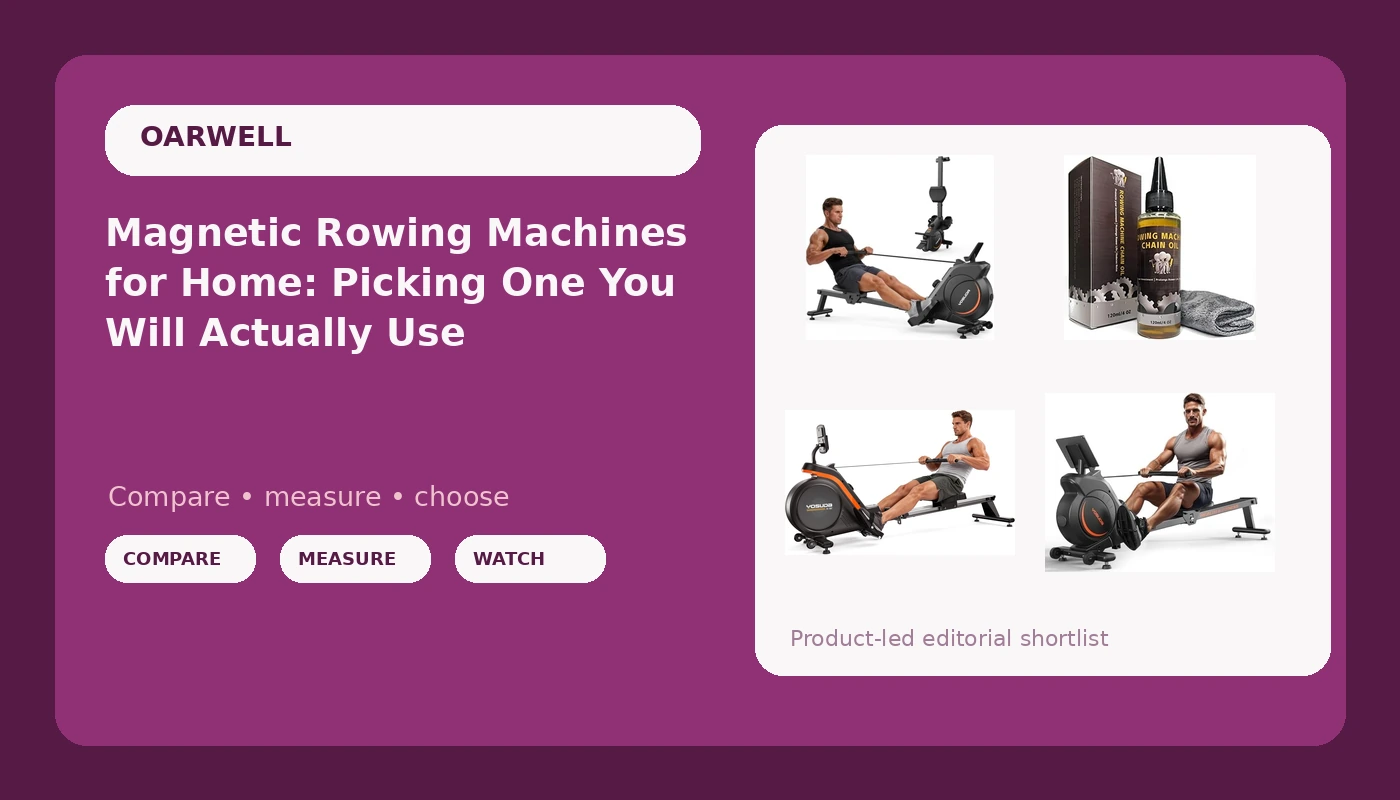
Most people shopping for a magnetic rowing machine for home are not really choosing between rowing and not rowing. They are choosing between a machine that fits the room they actually have and a machine that turns into an expensive place to hang laundry. Magnetic rowers sit on the practical side of that trade. They use magnets and a metal flywheel instead of a fan pulling air, so the frame can be smaller, the machine can often be stored, and the resistance does not depend on a large housing.
What the category does not give you is a standard. Two machines can both advertise 16 levels of resistance and feel completely different, and a product name will not tell you which one you are looking at. This is not a ranking and it is not a prediction of which machine you will love. It is a way to compare the four options below on the details that actually decide whether you keep rowing past the third week.
Related: Rowing Machine Maintenance Basics: Chain, Rail, and Seat →
Quick answer
For a home setup, the YOSUDA PRO is the option in this group with the higher stated weight capacity (400 lb) and a folding frame, while the two standard YOSUDA listings carry the same product name and the same stated 16-level magnetic resistance, so those two have to be compared on the product page rather than in prose. The TreadLife chain oil is not part of this decision at all. It is made for chain-drive rowers such as Concept2 models, and none of the magnetic machines here has a chain to oil.
If you want the short version: buy the machine that fits your space and your body, and buy the oil only if you already own a chain-drive erg.
Four options worth comparing
| Model | Best fit | What stands out |
|---|---|---|
| YOSUDA PRO Magnetic Rowing Machine for Home Use-Foldable Rower with 400lbs Weight Capacity and 16 Level Resistance | Rowers who want storage and a higher stated capacity | Stated 400 lb weight capacity and a foldable frame |
| YOSUDA Rowing Machine for Home, Magnetic Rower with 16-Level Resistance (first listing) | First-time buyers who want a simple magnetic machine | Stated 16 levels of magnetic resistance |
| YOSUDA Rowing Machine for Home, Magnetic Rower with 16-Level Resistance (second listing) | Buyers comparing the two identical-name listings | Same stated name and resistance as the other standard listing |
| TreadLife Fitness Concept 2 Rowing Machine Chain Oil | Owners of chain-drive rowers | Listing states compatibility with Concept2 models A through E |
The heavier-duty pick: YOSUDA PRO Magnetic Rowing Machine
A folding rower is only useful if you actually fold it. That sounds obvious, and it is the single most common way a folding machine goes wrong in a home: the owner folds it once, decides the process is more annoying than the floor space it saves, and leaves it open forever. If you are buying the PRO for storage, think honestly about whether you will break it down after a hard session when your legs are tired.
The higher stated weight capacity is the other reason to look at this one. Capacity is not a performance number, and a machine rated for 400 lb is not automatically a better rower than one rated lower. What capacity usually reflects is how much material went into the rail and the frame, and a stiffer rail is the difference between a seat that rolls smoothly and a seat that flexes under you at the finish. If you are tall or heavy, or you row hard, that is worth more than any monitor feature.
The entry option: YOSUDA Rowing Machine for Home
Here is the honest trade-off with any magnetic rower at this level: the resistance curve is smooth and consistent, but it is not the same experience as an air rower. On a fan-based machine the resistance builds with your effort, so a harder pull meets more resistance. On a magnetic machine the setting you choose is roughly the resistance you get, which makes it predictable and easy to row steady state on, and less rewarding for the kind of sprint work where the machine is supposed to fight back.
That does not make it a bad purchase. It makes it a purchase for a specific kind of training: steady 20 to 30 minute sessions, technique work, warm-ups, and days when you want to move without a lot of noise and air movement in the room. If your plan is intervals at maximum effort, you will notice the ceiling.
One technique note before you buy anything: the machine is maybe 20 percent of the workout. The other 80 percent is whether you sequence the stroke correctly, legs first, then the body swing, then the arms, and reverse it on the way back. A magnetic rower will happily let you pull with your arms and round your back for an hour. It will not correct you.
The matching listing: YOSUDA Rowing Machine for Home
Two listings with identical names is not a scam and it is not unusual. It happens when a seller runs multiple listings for the same model, when a version gets updated without the title changing, or when a bundle differs in a way the title never mentions. The problem is that you, the buyer, cannot tell which of those situations you are in from the name.
So treat the pair as a single decision with two doors. Open both, compare what is actually stated, and buy from whichever listing matches what you want. If both listings look identical in every stated detail, pick either one and stop agonizing over it. The difference between them, if there is one, is not something this article can verify for you.
The maintenance item: TreadLife Fitness Chain Oil
I am including this because it shows up in rowing searches constantly, and because it is the kind of add-on a first-time buyer puts in the cart without thinking. If you are buying a magnetic rower, skip it. There is no chain. If you own or are about to own a chain-drive machine, this is the routine item you keep on the shelf, and the maintenance habit matters more than the brand: a dry chain on a chain-drive erg is the beginning of a rough, noisy stroke that no amount of resistance adjustment will fix.
Prices and availability may change. Product images, names, and retailer links must be matched by verified ASIN. Do not state a current price, rating, stock status, or measured result without current evidence.
What 16 levels of magnetic resistance actually means
Magnetic rowers create resistance with magnets moving against a metal flywheel. As more of the magnet passes over the flywheel, the resistance rises. That is the whole mechanism, and it is why magnetic machines are compact and why the resistance is consistent from the first stroke to the last.
The number 16 is a manufacturer's scale, not a unit of measurement. Level 8 on one machine has no defined relationship to level 8 on another, and there is no industry body publishing the conversion. So when a listing says 16 levels, it is telling you the machine has a range with 16 stops in it. It is not telling you how heavy the top of that range is or how light the bottom is.
What you actually want to know is whether the easiest setting is light enough that a beginner can hold form for 20 minutes without muscling the stroke, and whether the hardest setting is heavy enough to make a 30-second interval feel like work. Those two things are not in the spec sheet. They are the reason a return policy matters more than a level count.
This is also where magnetic rowers differ from air rowers, and the difference is worth understanding before you buy. On an air rower, the damper setting is not the resistance. The damper changes how much air the fan can move, and the actual resistance number is the drag factor, which the monitor calculates. A heavier pull produces more resistance on its own. On a magnetic machine, you set the resistance and then you row against it. Predictable, less reactive, and for a lot of home training, completely fine.
How to compare two listings that share a name
The two standard YOSUDA listings here share a title, which makes them a good test case for a habit worth building. When names do not differentiate products, the listing details have to.
- Compare the stated weight capacity. It is one of the few numbers that reliably signals how much material is in the frame, and it is usually stated in the title or the first bullet.
- Compare the folded dimensions, not just the assembled footprint. A folding machine that stores at an awkward depth is a folding machine you will stop folding.
- Read what the listing says about the monitor. Look for whether it reports a split or pace per 500 meters, or only time, count, and calories. A monitor that shows split gives you an honest training number.
- Confirm the resistance type and the number of levels, and be suspicious if the two listings disagree on either.
- Check the return window and warranty terms on the exact listing you are buying from. With two same-name listings, the terms can differ even when the machine does not.
If the two listings match on all five, they are functionally the same purchase and you can stop comparing.
Practical guidance before you buy
- Measure the space twice, including the folded footprint and the clearance you need behind the machine at the finish.
- Set it up where you will actually row, not where it looks best. A rower in a spare room you never enter is a rower you never use.
- Learn the stroke sequence before you chase the numbers: legs, then body, then arms on the drive, and the reverse on the recovery. Slow the rate down until the sequence is automatic.
- Ignore the calorie readout. If the monitor shows a split, watch that instead. It is the number that reflects the work you are doing.
- Skip chain oil for any magnetic machine. Keep the rail clean, check that the seat rollers are rolling smoothly, and listen for a clicking seat. A squeak or a click is information, not a quirk to live with.
Which option should you choose?
Choose the YOSUDA PRO Magnetic Rowing Machine when you want the higher stated weight capacity in this group, you need a machine that folds, or you want a frame that is more likely to stay solid under a hard stroke. Choose the YOSUDA Rowing Machine for Home, Magnetic Rower with 16-Level Resistance when you want the simplest entry into indoor rowing at home and you are rowing steady sessions rather than all-out intervals. Choose the TreadLife Fitness Concept 2 Rowing Machine Chain Oil only when you own a chain-drive rower and you are keeping up with maintenance.
Between the two standard YOSUDA listings, choose whichever one matches on capacity, folded dimensions, monitor, and return terms when you open them side by side. If nothing distinguishes them, that is your answer.
A caveat worth stating plainly: none of these listings publishes a decibel figure, a drag factor, or a measured resistance range, and this article is not going to invent one. If you need to know how a machine feels at the catch, or how loud it is at 6 a.m. in an apartment, that is a question for the return policy and for your own first session, not for a spec table.
The bottom line
A magnetic rowing machine for home solves a real problem: it fits in rooms where an air rower would be a fight, it does not need a water tank, and it lets you train steadily without a lot of noise or air movement. It does not solve the problem of motivation, and it does not replicate the feel of an air erg or a boat.
Within this group, the YOSUDA PRO is the one with the higher stated capacity and the folding frame, and the two standard YOSUDA listings are the simple entry options whose real differences, if any, live on the product pages rather than in their names. The chain oil belongs in a different cart entirely, attached to a chain-drive machine. Pick the machine that fits your space and your body, learn the stroke properly, and give it a month before you decide whether it was the right call.