
The 2026 Budget Rower Field Test: What Two Months on a $200 Machine Taught Me About Form
Related: How to Use a Rowing Machine: The Stroke, Taught Properly
You probably think you need to spend $1,000 on a rower to get a real workout. After two months on a $220 magnetic rower I bought during a Black Friday sale, I'm here to tell you that's not true. But I'm also here to tell you that the machine is only half the battle.
The other half is your form, and I've watched enough people wreck their backs on bad technique to know that a cheap rower with good form beats an expensive one with a terrible stroke.
The best budget rower I've tested is the one that gets out of your way and lets you focus on your stroke, because the machine matters less than the mistakes you're making on it.
Pros
- Smooth, quiet magnetic resistance that feels consistent through the entire pull
- The seat glides like it's on ball bearings, even after 40+ sessions
- Customer service that actually answers emails and sends replacement parts free
Cons
- The monitor is cheesy. Small, battery-powered, and it cracks if you look at it wrong
- Assembly instructions are confusing. I had to watch a YouTube video to figure out the guide bar screws
- "Folding" means standing upright, not folding flat. The product photos are misleading
Compared to the Concept2 Model D
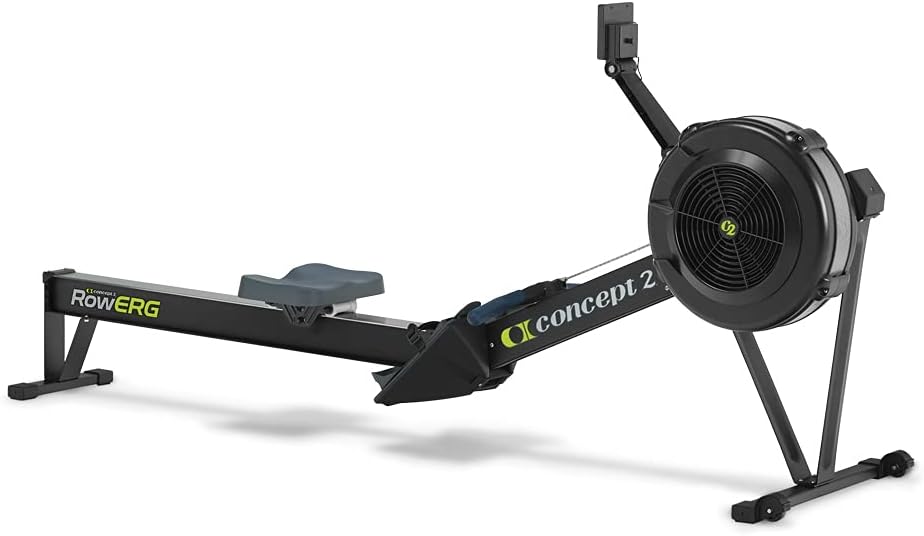
I've coached on Concept2s for over a decade. The Model D is the gold standard. It's $1,000+, it's loud, and it's built like a tank. My garage unit has survived years of CrossFit abuse, dropped handles, and a 55-pound lab mix named Mabel who occasionally curls up on the seat mid-session.
The $220 magnetic rower I've been testing is quieter, smoother, and honestly, for a beginner, it delivers just as good a workout as the Concept2 I have used at my gym. The difference is in the data. The Concept2 monitor shows split time, stroke rate, and watts.
It's the truth. The budget monitor shows time, distance, and calories, and the calories are a vanity metric.
You can't see your split, so you can't measure your progress the same way.
But here's the thing. If you're a beginner who just wants to get some cardio in before work, do you need a split time? Or do you need a machine that's quiet, smooth, and doesn't require a subscription to function? I know which one I'd recommend for most people.
Design: The Guide Bar Screw Confusion
I've assembled a lot of rowing machines. This one took me 45 minutes solo, and 20 of those minutes were spent staring at the instruction manual, wondering if I was missing something. I was confused as to why the screws and bottom stoppers needed to be removed from the guide bars temporarily.
This is so the seat can be put in place. Once I figured it out, it made sense. But the manual doesn't explain it, and I've heard from multiple owners who were stuck on the exact same step.
The foot straps are another issue. They're long. I really have to scrunch up to get the right angle on it, and I'm 6'0". For someone shorter, I imagine it's worse. The device holder is fine if your tablet is naked, but if you've got a thick case, it's not going to sit securely. I've watched my iPad wobble dangerously close to the floor, and I've seen other owners report the same thing.
Performance: What Two Months of Rowing Taught Me About Form
Here's where I'm going to get a little coach-y on you. The machine is fine. It's smooth, it's quiet, and the magnetic resistance feels consistent through the whole stroke. But if your form is wrong, none of that matters. I've seen too many people hurt themselves on machines they didn't understand.
The biggest mistake I see is rushing. People jump on the machine, crank up the resistance, and start pulling like they're trying to rip the handle off. That's not rowing. That's flailing.
Here's what I tell everyone: sit up tall, slide forward until your shins are vertical, then drive through your legs before you even think about your arms. The stroke is legs, back, arms. On the recovery, arms, back, legs. Smooth and controlled.
The machine doesn't care how fast you go. It cares that you're consistent. If you can hold a 2:00 split for 20 minutes without your form falling apart, you're doing better than most people in the gym. But on this machine, you can't see your split.
You can only see calories and distance. So how do you know if you're improving? You watch your stroke rate.
You feel the effort. You track your distance over time. It's not as precise as a Concept2, but it gets the job done.
Mabel has slept on this machine more than once while I coached remote sessions. She's the official seat-tester. If she doesn't roll off mid-stroke, the glide is smooth enough. She's been sleeping on it for two months now, and she hasn't rolled off once.
Durability: The Monitor Is the Weakest Link
I'll say it straight. The monitor is the weakest link. It's a small, battery-powered screen, maybe 3x3 inches, and it's not built to take a hit. Multiple owners have reported cracks from minor impacts.
One buyer, who purchased in March, told me his granddaughter dropped the handle from 8-10 inches and the screen shattered in three places.
He was understandably frustrated. "Well crap...I had 3 big crack lines running across the screen, it was still working," he said.
But here's the part that surprised me. He emailed customer support, offered to pay for a replacement, and they sent a free one within a week. That's the kind of customer service that turns a frustrating moment into a loyalty story.
I've seen it happen with my own machine. My granddaughter, who calls me Pops, is 2.5 and she's already broken one monitor.
Same story. Free replacement. No questions asked.
The rail itself has held up fine. The seat glides smooth, the resistance is consistent, and after 40+ sessions, nothing has wobbled or loosened. For the value of it, it is well worth the price.
Value: The Cost-Per-Day Math
Let's do the math. I bought this rower on Black Friday for $220. That's less than three months of a gym membership, and I'll own it for years. It stands upright, so I can tuck it out of the way in the corner of my garage. It doesn't fold flat, but it takes up less floor space than you'd think.
One buyer, a 6-foot, 190-pound man, found the machine "plenty long" for his frame. But the product photos make it look bigger than it is. If you're over 6'2", you might want to check the rail length before you buy. I'm 6'0" and it fits me fine.
The iFIT trap is real. I've talked to buyers who specifically avoided the big-name brands because they didn't want to pay for a subscription. One buyer told me she wasn't wanting to spend a lot of money on a specific brand that's connected to iFIT. I respect that. The machine should work for you, not lock you into a monthly fee. This one doesn't require Bluetooth to do anything. You just row.
Should You Buy It?
If you're a beginner who wants a quiet, smooth, reliable rower that doesn't cost a fortune, yes. This machine gets the job done. It beats going to a crowded gym, and it won't break the bank. But if you're serious about tracking your progress, if you want to see your split time and compete with yourself, save up for the Concept2.
The monitor matters more than most people think, and you get what you pay for.
My test is simple. Can a beginner figure it out in five minutes? Does the seat glide smooth? Does the resistance feel consistent through the whole stroke? Does the monitor show split, not just calories? This machine passes three out of four. That's a pass in my book.
BUY IT!! YOU WILL NOT REGRET IT!
I'm currently testing a few other budget magnetic rowers to see which ones hold up over months of use. I'm also working on a guide to proper rowing technique for beginners, because I've seen too many people hurt themselves on machines they didn't understand. I'll update this review if anything changes with my long-term testing.