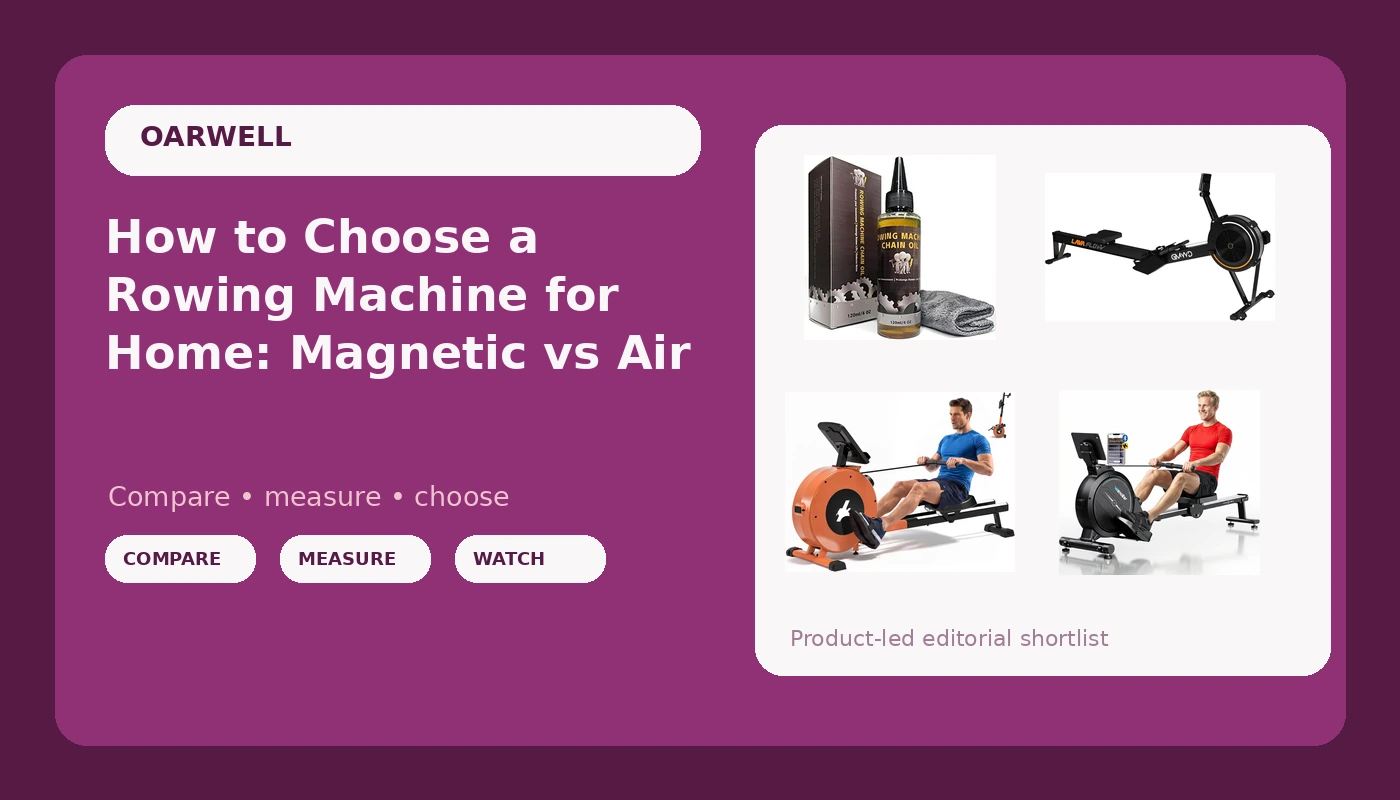
Buying a rowing machine for home comes down to two questions that have nothing to do with how the machine looks in a product photo. First, how does it create resistance, because that decides how the stroke feels and how loud your living room gets at 6 a.m. Second, will you maintain it, because a chain-drive rower that never sees oil will tell you about it through a rough, grinding pull. Everything else, the screen, the fold, the seat, is a detail you can rank once those two are settled.
Related: Rowing Machine Maintenance: Keeping a Chain-Drive Rower Smooth →
Quick answer
Resistance type is the first fork in the road. A magnetic rower runs quietly and needs almost no upkeep, which is why most compact and folding machines use it. An air rower like the GMWD Lava Flow Series changes resistance with your effort, so a harder pull meets more resistance, and that is the sensation most people mean when they say a machine feels like rowing. If you own a chain-drive rower, whether that is a Concept2 or something older, a dedicated chain oil belongs in your maintenance kit. Whichever machine you pick, confirm that the monitor reports a split, which is time per 500 meters, and not only calories.
Four useful options
| Model | Best fit | What stands out |
|---|---|---|
| GMWD Air Rowing Machine, Lava Flow Series | Full-effort intervals and paced sessions | Air resistance with 10 levels of adjustment, performance monitor, device holder |
| Wenoker Magnetic Rowing Machine | Quiet daily sessions in shared space | Magnetic resistance described as quiet and smooth, full-body home workout |
| Rowing Machines Foldable for Home, 16-Level Magnetic | Small rooms that double as something else | Folds for storage, dual slide rail, LCD monitor with app support, 350 lb capacity |
| TreadLife Fitness Concept 2 Rowing Machine Chain Oil | Chain-drive owners | Lubricates and protects the chain from rust and dirt, fits Concept 2 models A through E |
The air rower: GMWD Air Rowing Machine, Lava Flow Series
The trade-off with air is noise. The fan that gives you that honest, effort-matched resistance is also the part your downstairs neighbor hears. On an air machine, the resistance setting works like a damper: it changes how much air the fan moves, which changes the feel of the drive, not the difficulty of a given pace. If you are chasing intervals and want the machine to punish a hard pull, this is the design that does it.
The quiet starter: Wenoker Magnetic Rowing Machine
Here is the honest limitation of magnetic resistance, and it applies to every machine in this category, not just this one. A magnetic brake is closer to a fixed setting than a living one. Pull harder and you mostly move faster, but the resistance does not grow with you the way air does. That makes magnetic excellent for steady-state work, warm-ups, and people who want a machine they will actually use without waking anyone. It makes it less satisfying for all-out sprint intervals, where the point is that the machine fights back.
The space saver: Rowing Machines Foldable for Home, 16-Level Magnetic
A folding rower only helps if you fold it, and the joint is the part that decides whether the rail stays rigid when it is open. When you assemble any folding machine, sit on it, pull a few hard strokes, and listen. If the rail flexes or the seat clicks across the hinge, that is the machine telling you something before you have built a habit around it. The 16 resistance levels are useful for finding a warm-up setting and a working setting, but remember what the resistance type means: this is still a magnetic brake.
The upkeep pick: TreadLife Fitness Concept 2 Rowing Machine Chain Oil
A dry chain adds noise and drag, and over time it wears faster than it needs to. Chain oil is cheap insurance on the most mechanically honest machines in rowing. It is not a fix for everything, though: if your machine feels rough, also check chain tension, the seat rollers, and whether dust has collected in the rail track. Lubricant solves a lubrication problem and nothing else.
Prices and availability may change. Product images, names, and retailer links are matched to verified listings. No current price, rating, stock status, or measured result is stated here without current evidence.
What the monitor should tell you
The monitor is the part of a rowing machine that decides whether you improve or just get tired. The number that matters is the split, which is your pace expressed as time per 500 meters. It is honest in a way that calorie estimates are not, because calories on a rowing monitor are a calculation based on assumptions about your body, not a measurement. If a monitor shows only calories, you are training blind.
Stroke rate, usually shown as strokes per minute, is the second number worth watching. Beginners tend to rate too high and pull too light, rushing up and down the rail. Slower, stronger strokes at a lower rate are almost always the fix. On a machine with a damper or resistance lever, the setting is a feel adjustment, not a difficulty score. Higher is not better. Most people row better at a moderate setting, and on a Concept2 the number that actually tells you about resistance is the drag factor, which the monitor can display.
So when you compare machines, ask what the screen reports. Split and stroke rate are the two that change how you train. A device holder and app support are genuinely useful, because they let you follow a guided session instead of guessing.
Resistance types and what they mean in a small room
Air resistance uses a fan. The harder you pull, the more air it moves, so resistance rises with effort. This is the closest most home machines get to the feel of a boat, and it is loud.
Magnetic resistance uses a brake near a flywheel. It is quiet, it needs no fluid or chain care, and it holds a steady feel. It does not scale with effort the same way, so it suits steady work more than sprints.
Water resistance uses a tank and paddles. It sounds and feels wonderful, but the tank is a maintenance project and the water needs attention.
Hydraulic resistance uses pistons and is mostly found on very small, very cheap machines. The stroke feel is different from rowing, and it is worth being cautious here.
There is also the question of chain versus cord versus belt drive. A chain-drive machine, like the Concept2 family, is durable and serviceable, which is why chain oil exists as a product category. A cord or belt drive is quieter and needs less attention.
- Decide whether you want a fixed feel (magnetic) or effort-matched resistance (air).
- Measure the space, including the length of the rail with the machine open, not folded.
- Check what the monitor reports. Split and stroke rate first, everything else second.
- Confirm the seat rolls smoothly and quietly across the full length of the rail.
- Budget for upkeep. Chain oil for a chain-drive machine, and a plan for water if you go that route.
Setting up a home rowing routine that survives week three
- Set a realistic session length. Twenty minutes of steady rowing, done four times a week, beats an hour you do once.
- Learn the catch and the finish before you chase pace. Most form breaks down at the ends of the stroke, not the middle.
- Ignore the calorie readout and watch the split. It is the number that responds to your training.
- Keep the machine where you can see it. A rower stored behind three boxes becomes a clothes rack.
- Log your sessions somewhere simple, even a note on your phone. Pace trends tell you more than any single workout.
Which option should you choose?
Choose the GMWD Air Rowing Machine, Lava Flow Series when you want resistance that scales with effort and you can live with fan noise. Choose the Wenoker Magnetic Rowing Machine when quiet operation and simple, low-maintenance daily sessions matter more than sprint feel. Choose the Rowing Machines Foldable for Home when floor space is the constraint and the machine has to disappear between sessions. Add the TreadLife Fitness Concept 2 Rowing Machine Chain Oil if you own or plan to own any chain-drive rower, because that machine will reward you for the ten minutes of care.
One caveat worth stating plainly: the details above come from the product listings, not from lab measurement. Fit, noise, and feel vary by body size and by room, so check the listed dimensions and capacity against your own space and weight before you buy, and treat any resistance setting as something to adjust by feel rather than by number.
The bottom line
For a home setup, resistance type is the decision that shapes everything else. Air gives you the honest, effort-matched stroke and asks you to accept the noise. Magnetic gives you quiet, low-maintenance sessions and asks you to accept a steadier feel. Folding solves a space problem, and a bottle of chain oil solves the most common neglect problem on the machines that last the longest. Pick the resistance that matches the workout you will actually do, confirm the monitor shows a split, and keep the chain lubed if you have one.